
Achieving 15% More Efficiency with Low-Code Development in US Enterprises: A 2026 Blueprint
In the rapidly evolving digital landscape, US enterprises are constantly seeking innovative solutions to enhance operational efficiency, accelerate time-to-market, and maintain a competitive edge. The promise of achieving a 15% increase in efficiency by 2026 might seem ambitious, but with the strategic adoption of low-code development, this goal is not only attainable but also a critical necessity. This comprehensive blueprint outlines practical solutions and a clear roadmap for US businesses to leverage low-code platforms, transforming their development cycles and fostering unprecedented business agility.
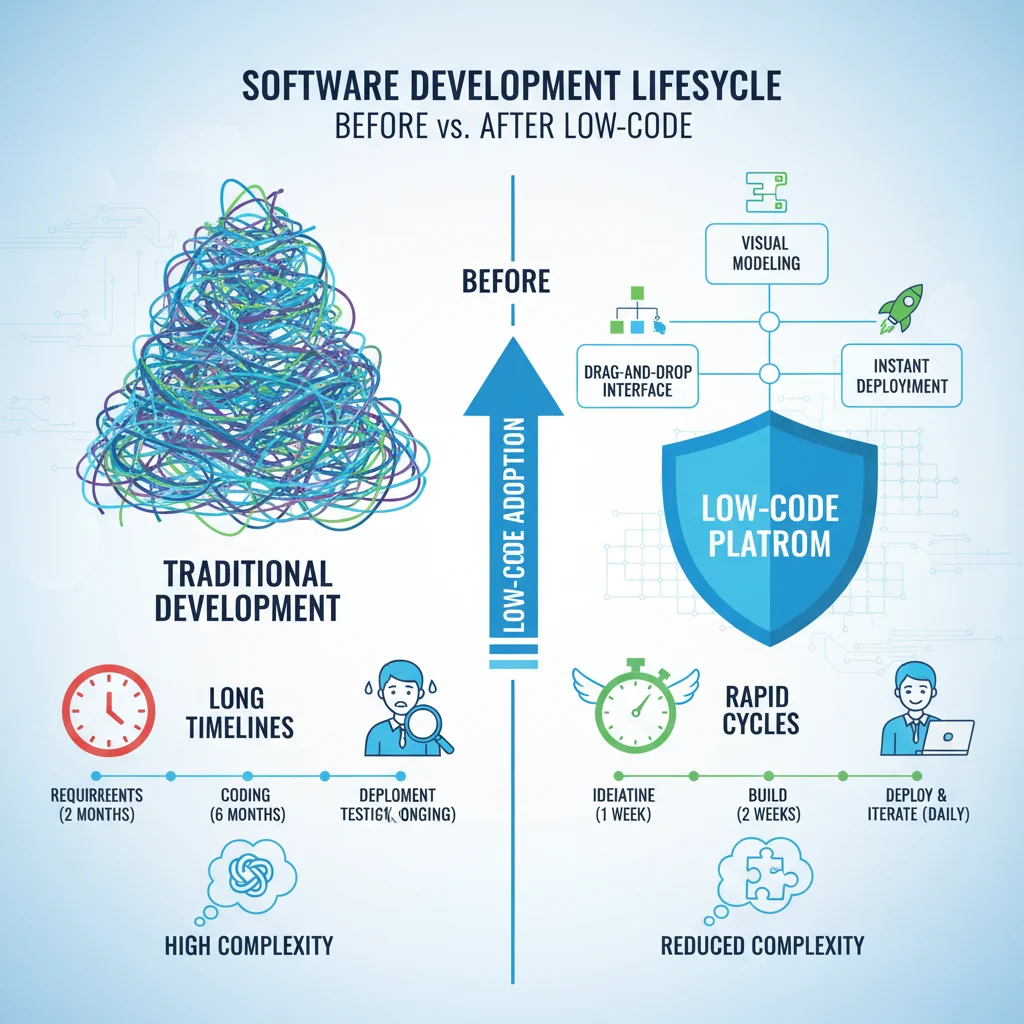
The traditional software development paradigm, characterized by lengthy coding processes, specialized talent requirements, and often rigid methodologies, struggles to keep pace with modern business demands. Enterprises are grappling with a growing backlog of applications, a shortage of skilled developers, and the urgent need for rapid digital transformation. Low-code development emerges as a powerful antidote, offering a visual, model-driven approach to application development that drastically reduces the need for manual coding.
The Imperative for Low-Code in US Enterprises
The drive for greater enterprise efficiency is multifaceted. It involves streamlining internal operations, improving customer experiences, optimizing resource allocation, and fostering a culture of continuous innovation. Low-code platforms address these challenges head-on by:
- Accelerating Application Development: By using visual interfaces, pre-built components, and drag-and-drop functionality, low-code significantly reduces the time and effort required to build and deploy applications. This allows businesses to respond more quickly to market changes and customer needs.
- Bridging the IT Skills Gap: The shortage of experienced developers is a persistent problem. Low-code empowers ‘citizen developers’ – business users with domain expertise but limited coding knowledge – to build applications, thereby expanding the development workforce and freeing up professional developers for more complex, strategic projects.
- Enhancing Business-IT Alignment: The visual nature of low-code platforms facilitates better communication and collaboration between business stakeholders and IT teams. Business users can actively participate in the development process, ensuring that the applications truly meet their requirements.
- Reducing Costs: Faster development cycles, fewer specialized resources, and easier maintenance contribute to significant cost savings in the long run.
- Fostering Innovation: With the ability to rapidly prototype and iterate, enterprises can experiment more freely with new ideas, leading to a culture of continuous innovation.
Understanding the 15% Efficiency Target for 2026
Achieving a 15% boost in low-code enterprise efficiency by 2026 is a measurable and impactful goal. This efficiency gain can manifest in various ways:
- Reduced Development Time: A 15% reduction in the average time taken to develop and deploy new applications or features.
- Increased Application Delivery: A 15% increase in the number of business-critical applications delivered within a given timeframe, without increasing IT headcount.
- Operational Cost Savings: A 15% decrease in the operational costs associated with maintaining and updating legacy systems, or the cost per application developed.
- Improved Business Process Automation: A 15% improvement in the automation of manual business processes, leading to faster execution and fewer errors.
- Enhanced Employee Productivity: A 15% increase in the productivity of employees due to better, more tailored applications that streamline their workflows.
The cumulative effect of these improvements will be a more agile, responsive, and ultimately more profitable enterprise. The blueprint for achieving this ambitious target involves a structured approach to low-code adoption, encompassing strategy, technology, people, and processes.
Practical Solutions: A Phased Approach to Low-Code Adoption
Phase 1: Strategic Planning and Pilot Programs
The journey to enhanced low-code enterprise efficiency begins with a clear strategy. Enterprises should not rush into widespread adoption without thorough planning.
1. Identify Key Business Pain Points and Opportunities:
Start by pinpointing areas within the organization where traditional development methods are creating bottlenecks, or where there’s a significant opportunity for process improvement through new applications. These could include:
- Legacy system modernization
- Manual, paper-based workflows
- Customer service inefficiencies
- Data collection and reporting challenges
- Lack of integration between disparate systems
2. Select the Right Low-Code Platform:
The market offers a variety of low-code platforms, each with its strengths. Key considerations for US enterprises include:
- Scalability: Can the platform grow with your business needs?
- Integration Capabilities: How well does it integrate with existing enterprise systems (ERPs, CRMs, databases)?
- Security and Compliance: Does it meet industry-specific regulations and data security standards?
- User-Friendliness: Is it intuitive for both professional and citizen developers?
- Vendor Support and Ecosystem: What kind of support, training, and community resources are available?
- Pricing Model: Understand the licensing and operational costs.
3. Conduct a Pilot Project:
Before a full-scale rollout, initiate a small, well-defined pilot project. This allows the organization to:
- Test the chosen low-code platform in a real-world scenario.
- Identify potential challenges and refine processes.
- Demonstrate tangible value and build internal champions.
- Train initial users and gather feedback.
A successful pilot project is crucial for building momentum and securing broader organizational buy-in for the low-code enterprise efficiency initiative.
Phase 2: Building Internal Capabilities and Governance
As the pilot concludes, the focus shifts to scaling up capabilities and establishing robust governance frameworks.
1. Establish a Low-Code Center of Excellence (CoE):
A CoE is vital for driving successful low-code adoption. This cross-functional team should:
- Define best practices, standards, and guidelines for low-code development.
- Provide training and support to both professional and citizen developers.
- Manage platform licenses and security protocols.
- Evaluate new low-code tools and features.
- Act as a central resource for all low-code initiatives.
2. Train and Empower Citizen Developers:
Leveraging citizen developers is a cornerstone of maximizing low-code enterprise efficiency. Provide comprehensive training programs that cover:
- Platform functionality and features.
- Application design principles.
- Data security and governance policies.
- Collaboration tools and processes for working with IT.
This empowerment democratizes development and significantly expands the organization’s capacity to build applications.
3. Implement Robust Governance and Security Policies:
While low-code accelerates development, it’s crucial not to compromise on security or compliance. Establish clear policies for:
- Access control and user permissions.
- Data privacy and protection (e.g., GDPR, CCPA).
- Application testing and quality assurance.
- Version control and deployment pipelines.
- Auditing and monitoring of low-code applications.
These policies ensure that the rapid development facilitated by low-code does not introduce new risks to the enterprise.
Phase 3: Scaling, Integration, and Continuous Improvement
With foundational elements in place, enterprises can now scale their low-code initiatives and integrate them deeply into their IT ecosystem.
1. Integrate Low-Code with Existing Systems:
For low-code applications to deliver maximum value, they must seamlessly integrate with existing enterprise systems (ERPs, CRMs, data warehouses, IoT devices). Focus on:
- Utilizing APIs and connectors provided by the low-code platform.
- Developing custom integrations where necessary.
- Ensuring data consistency and flow across all connected systems.
Robust integration is key to unlocking the full potential of low-code enterprise efficiency by eliminating data silos and automating end-to-end processes.
2. Adopt a Hybrid Development Model:
The most effective approach often involves a hybrid model where professional developers handle complex, core system development (sometimes using low-code for parts) and citizen developers build departmental or niche applications. This optimizes resource allocation and leverages the strengths of both groups.
3. Foster a Culture of Continuous Improvement and Iteration:
Low-code’s agility makes it ideal for iterative development. Encourage teams to:
- Gather user feedback regularly and rapidly incorporate changes.
- Monitor application performance and user adoption.
- Continuously identify new opportunities for low-code application development and process automation.
This agile mindset ensures that applications remain relevant and continue to deliver value, contributing to sustained low-code enterprise efficiency.
Key Technologies and Trends Driving Low-Code Efficiency
The low-code landscape is constantly evolving, with several technologies enhancing its capabilities and driving greater efficiency:
- Artificial Intelligence (AI) and Machine Learning (ML): Integrating AI/ML capabilities into low-code platforms allows for smarter applications, predictive analytics, and enhanced automation. This can range from AI-powered recommendations within the development environment to embedding AI models directly into business applications.
- Robotic Process Automation (RPA): Low-code platforms often integrate with RPA tools to automate repetitive, rule-based tasks across various systems, further amplifying efficiency gains.
- Cloud-Native Architectures: Most modern low-code platforms are cloud-native, offering scalability, reliability, and global accessibility, which are crucial for large US enterprises.
- Microservices and API-First Design: Low-code platforms increasingly support microservices architectures and API-first design principles, enabling modular, reusable components and easier integration with other systems.
- Process Mining and Business Process Management (BPM): Tools that help analyze and optimize business processes are often integrated with low-code platforms, ensuring that the applications being built truly address process inefficiencies.
Measuring Success: KPIs for 15% Efficiency Gain
To confirm the 15% efficiency gain by 2026, enterprises must establish clear Key Performance Indicators (KPIs) and regularly track their progress. Relevant KPIs include:
- Application Development Cycle Time: Track the average time from conception to deployment for new applications and features.
- Development Cost Per Application: Monitor the total cost (resources, licenses, maintenance) associated with developing and deploying applications.
- Backlog Reduction Rate: Measure the rate at which the application development backlog is decreasing.
- Number of Applications Delivered: Quantify the increase in the number of applications built and deployed annually.
- Citizen Developer Engagement: Track the number of active citizen developers and the applications they contribute.
- Process Automation Rate: Measure the percentage of business processes that have been automated or significantly streamlined.
- User Satisfaction: Collect feedback from end-users on the usability and effectiveness of low-code applications.
- Return on Investment (ROI): Calculate the financial benefits derived from low-code initiatives compared to the investment.
Regular reporting and analysis of these KPIs will provide concrete evidence of the efficiency improvements and allow for adjustments to the strategy as needed, ensuring the low-code enterprise efficiency target remains on track.

Challenges and Mitigation Strategies
While low-code offers immense benefits, enterprises must be aware of potential challenges and develop strategies to mitigate them:
- Shadow IT: Uncontrolled proliferation of applications built by citizen developers without IT oversight can lead to security risks and integration issues. Mitigation: Strong governance, CoE guidance, and clear policies for application approval and deployment.
- Vendor Lock-in: Dependence on a single low-code platform can limit flexibility. Mitigation: Choose platforms with strong integration capabilities, open standards, and consider a multi-platform strategy for diverse needs.
- Scalability and Performance Concerns: Some low-code platforms might struggle with very high transaction volumes or complex enterprise-level requirements. Mitigation: Thoroughly evaluate platform capabilities during selection, conduct stress testing, and design applications with scalability in mind.
- Resistance to Change: Employees (both IT and business) might be resistant to new tools and methodologies. Mitigation: Comprehensive training, clear communication of benefits, executive sponsorship, and celebrating early successes.
- Security and Compliance: Ensuring all low-code applications meet enterprise security standards and regulatory requirements. Mitigation: Integrate security testing into the development lifecycle, enforce strict access controls, and leverage platform security features.
The Future Outlook: Low-Code as a Strategic Imperative
By 2026, low-code development will no longer be a niche solution but a fundamental component of the IT strategy for most US enterprises. Its ability to empower a broader range of employees to contribute to digital transformation, coupled with its speed and efficiency, makes it indispensable. Enterprises that proactively embrace and strategically implement low-code development will be the ones that achieve significant competitive advantages, characterized by:
- Hyper-Agility: The ability to adapt quickly to market changes and innovate at an unprecedented pace.
- Enhanced Customer Experiences: Rapidly deploy tailored applications that meet evolving customer demands.
- Operational Excellence: Streamlined internal processes, reduced manual effort, and optimized resource utilization.
- Data-Driven Decisions: Better applications leading to better data collection and analysis, informing strategic choices.
The 15% efficiency gain is not just a number; it represents a profound shift in how US enterprises will operate, innovate, and thrive in the coming years. It’s about building a future where technology serves business needs with unparalleled speed and precision.
Conclusion
The blueprint for achieving a 15% increase in low-code enterprise efficiency by 2026 is clear. It demands a strategic vision, careful platform selection, robust governance, comprehensive training, and a commitment to continuous improvement. US enterprises that embark on this journey will not only overcome current development challenges but also unlock new levels of agility, innovation, and competitiveness. Low-code development is not just a tool; it’s a transformative methodology that is reshaping the future of business application development and driving tangible, measurable efficiency gains across the enterprise landscape.
Embrace low-code now to solidify your enterprise’s position at the forefront of digital innovation and ensure sustainable growth well beyond 2026.