Space Exploration’s New Frontier: 3 U.S. Initiatives Shaping Off-World Industries Post-2026

Space Exploration’s New Frontier: 3 U.S. Initiatives Shaping Off-World Industries Post-2026
The dawn of a new era in space exploration is upon us, with the United States at the forefront of pioneering ambitious endeavors that promise to redefine humanity’s relationship with the cosmos. As we look beyond 2026, the focus is shifting from mere exploration to the sustainable development of off-world industries, creating an entirely new economic landscape. These U.S. space initiatives are not just about reaching new destinations; they are about building the infrastructure, fostering the technologies, and establishing the policies that will enable a permanent, thriving human presence beyond Earth. This article will delve into three pivotal U.S. space initiatives that are poised to shape the future of off-world industries, discussing their scope, potential impact, and the challenges they aim to overcome.
The Artemis Program: Laying the Foundation for a Lunar Economy
At the heart of the U.S.’s renewed push into deep space is the Artemis Program. More than just a return to the Moon, Artemis is designed to establish a sustainable human presence on and around the lunar surface. This ambitious undertaking is not a repeat of the Apollo missions; it’s a strategic effort to build the foundational elements for a robust lunar economy, paving the way for future off-world industries. The program envisions a continuous cycle of missions, culminating in the construction of permanent habitats, research facilities, and resource utilization infrastructure. These U.S. space initiatives under Artemis are crucial for developing the technologies and operational expertise needed for long-duration space missions and eventual human settlement.
Establishing a Lunar Gateway and Surface Infrastructure
A cornerstone of the Artemis Program is the Lunar Gateway, a small space station orbiting the Moon. The Gateway will serve as a multi-purpose outpost, providing vital support for missions to the lunar surface and acting as a staging point for future deep space expeditions. Its modular design allows for expansion and adaptation, accommodating various international and commercial partners. This strategic orbital platform will facilitate scientific research, technology demonstrations, and act as a communications relay, significantly enhancing the capabilities of lunar surface operations. The development of the Gateway is a prime example of the collaborative nature of these U.S. space initiatives, bringing together global expertise and resources.
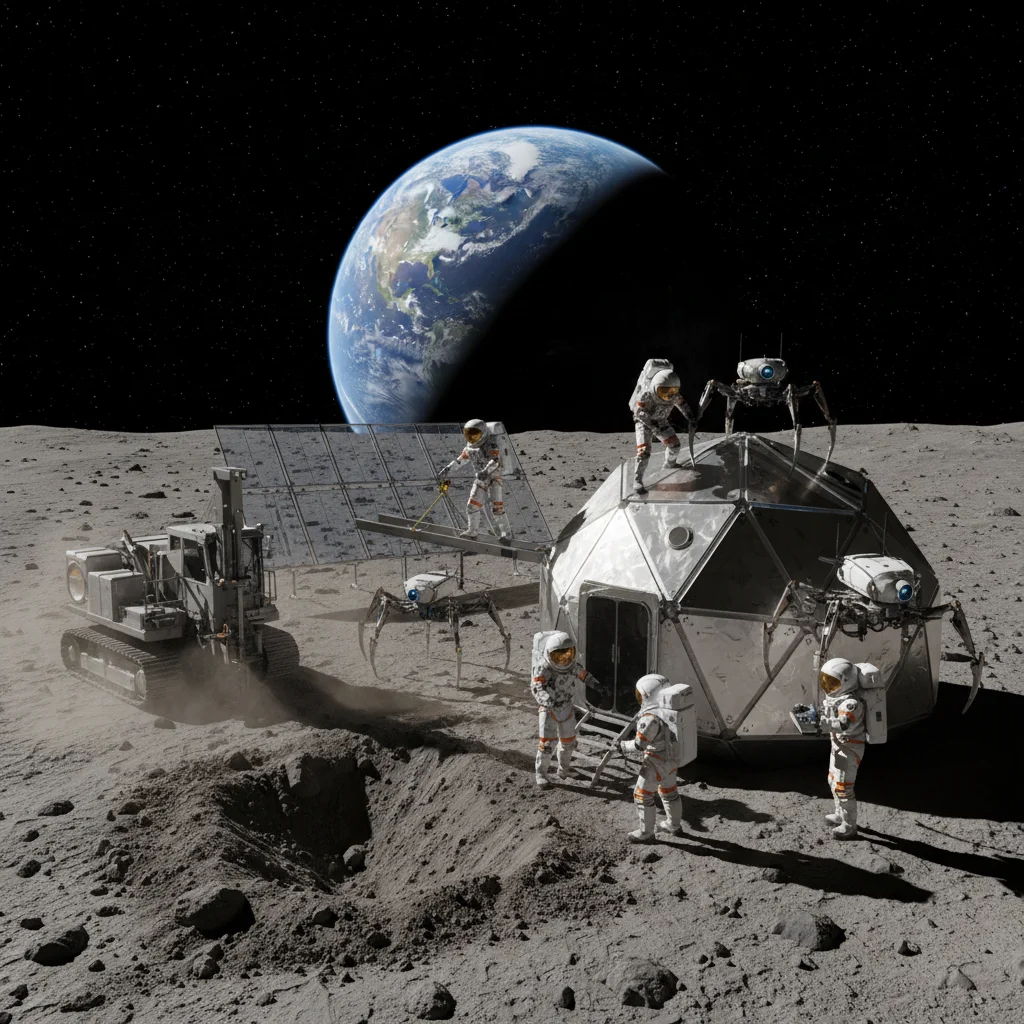
On the lunar surface, Artemis aims to establish the Artemis Base Camp in the Moon’s South Pole region. This permanent outpost will be critical for sustained human operations. The South Pole is of particular interest due to the potential presence of water ice in permanently shadowed craters, a resource vital for drinking water, oxygen production, and rocket fuel. Developing the infrastructure for extracting and processing this water ice, known as In-Situ Resource Utilization (ISRU), will be a game-changer for off-world industries. It reduces the reliance on costly supplies from Earth, making lunar operations more sustainable and economically viable. The ability to ‘live off the land’ is a fundamental step towards true space industrialization.
Commercial Partnerships and Lunar Resource Utilization
A key differentiator of the Artemis Program from previous lunar endeavors is its strong emphasis on commercial partnerships. NASA is actively engaging private companies to develop lunar landers, habitats, and resource extraction technologies. This commercialization strategy is designed to foster a competitive and innovative environment, driving down costs and accelerating technological development. Companies are being encouraged to explore business models centered around lunar tourism, asteroid mining, and even manufacturing in space. These U.S. space initiatives are creating a fertile ground for entrepreneurs and investors to venture into the nascent lunar economy.
The potential for lunar resource utilization extends beyond water ice. The Moon is rich in valuable minerals, including rare earth elements and helium-3, a potential fuel for future fusion reactors. While the extraction of these resources is still in its early stages of research and development, the Artemis program is setting the stage for their eventual commercial exploitation. The legal and regulatory frameworks for property rights and resource ownership in space are also being actively discussed and developed, forming another critical aspect of these U.S. space initiatives. The establishment of these frameworks will be essential for attracting investment and ensuring the long-term viability of lunar industries.
Commercial Low Earth Orbit (LEO) Development: A New Space Economy Hub
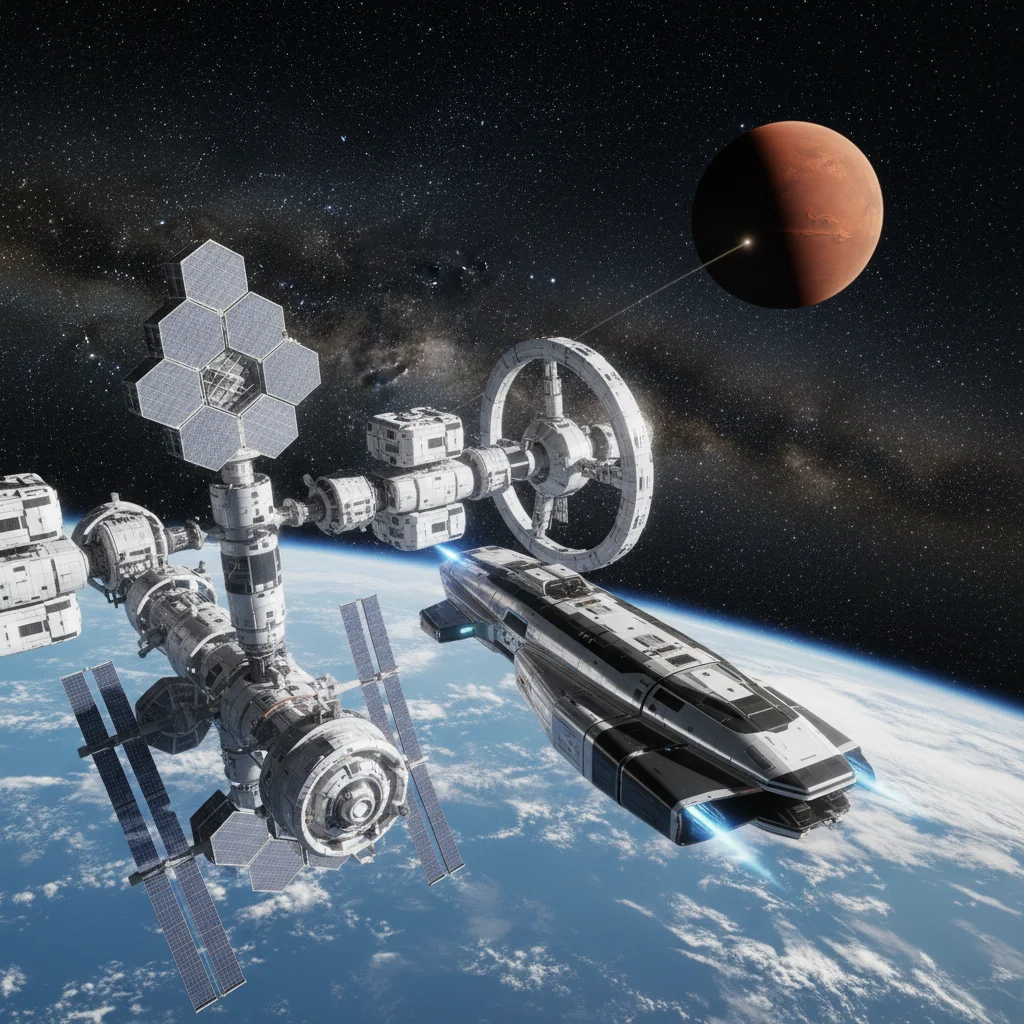
While Artemis looks to the Moon, another significant area of focus for U.S. space initiatives is the commercialization of Low Earth Orbit (LEO). With the International Space Station (ISS) nearing the end of its operational life, NASA is actively supporting the development of commercial space stations and platforms in LEO. The goal is to transition from a government-operated space station to a multi-user, commercially run ecosystem, freeing up NASA’s resources for deep space exploration while fostering a vibrant and competitive LEO economy.
Transitioning from ISS to Commercial Space Stations
The ISS has been an unparalleled success, demonstrating the feasibility of long-duration human presence in space and fostering international collaboration. However, its operational costs are substantial, and its aging infrastructure requires significant maintenance. NASA’s strategy is to facilitate the development of multiple commercial LEO destinations (CLDs) that can cater to a diverse range of users, including government agencies, private companies, and even space tourists. This transition is a critical component of current U.S. space initiatives.
Several U.S. companies, such as Axiom Space, Orbital Reef (Blue Origin/Sierra Space), and Starlab (Voyager Space/Airbus), are already developing designs for commercial space stations. These stations are envisioned to offer various services, including microgravity research and manufacturing, in-space assembly, astronaut training, and space tourism. By creating a competitive market for LEO platforms, NASA aims to reduce its operational costs and ensure continued access to the unique microgravity environment for scientific research and technological development. This strategic shift will democratize access to space, opening doors for innovation that was previously unimaginable.
Microgravity Manufacturing and In-Space Services
The microgravity environment of LEO offers unique opportunities for manufacturing advanced materials and pharmaceuticals that cannot be produced on Earth. For example, fiber optics with superior properties, high-quality semiconductor crystals, and novel biomedical products can be manufactured in space, creating entirely new industries. These U.S. space initiatives are actively funding research and development in these areas, recognizing the immense economic potential.
Beyond manufacturing, commercial LEO platforms will also provide a host of in-space services. This includes satellite servicing, debris removal, and even space-based power generation. As the number of satellites in orbit continues to grow, the need for these services will become increasingly critical. Commercial companies are developing robotic technologies and specialized spacecraft to address these challenges, creating a sustainable ecosystem for orbital operations. The development of these capabilities is integral to the long-term viability of space as a domain for economic activity.
Mars Sample Return and Future Human Missions: Pioneering Deep Space Exploration
While the Moon and LEO offer immediate opportunities, the ultimate goal of human space exploration remains Mars. The U.S. is committed to sending humans to Mars, and the current Mars Sample Return (MSR) mission is a crucial step in that direction. MSR is a highly ambitious endeavor that aims to bring Martian rock and soil samples back to Earth for detailed scientific analysis, providing invaluable data for future human missions and understanding the potential for life beyond Earth. These U.S. space initiatives are not just about science; they are about proving the technologies and operational capabilities needed for interplanetary travel and colonization.
The Significance of Mars Sample Return
The Mars Sample Return mission, a collaboration between NASA and the European Space Agency (ESA), is arguably one of the most complex robotic missions ever attempted. It involves multiple spacecraft and intricate maneuvers to collect samples from the Martian surface, launch them into Mars orbit, and then return them safely to Earth. The scientific payoff from these samples is expected to be immense, potentially answering fundamental questions about the formation of our solar system, the history of Mars, and the possibility of past or present life on the Red Planet.
Beyond the scientific discoveries, MSR is a critical precursor to human missions to Mars. It will test key technologies such as precision landing, ascent from a planetary surface, and orbital rendezvous in a deep space environment. The data gathered from the samples will also inform mission planners about potential hazards for human explorers, such as dust composition and radiation levels, allowing for better design of habitats and protective measures. These U.S. space initiatives are meticulously planned to mitigate risks and maximize the chances of success for future human endeavors.
Developing Technologies for Human Mars Missions
Sending humans to Mars presents enormous technical and logistical challenges. A round trip could take several years, exposing astronauts to prolonged periods of radiation, microgravity, and isolation. NASA and its partners are actively developing advanced propulsion systems, such as nuclear thermal propulsion, to reduce transit times. They are also researching closed-loop life support systems that can recycle air, water, and waste, making long-duration missions more sustainable and less reliant on resupply from Earth. These U.S. space initiatives are pushing the boundaries of engineering and scientific innovation.
Furthermore, the development of robust habitats that can protect astronauts from the harsh Martian environment, including radiation and dust storms, is a top priority. In-situ resource utilization on Mars, similar to the Moon, will be essential for producing water, oxygen, and even propellants from the Martian atmosphere and soil. The ability to manufacture tools and spare parts using 3D printing technologies on Mars will also reduce the need to transport everything from Earth, further enabling a self-sufficient human presence. The cumulative efforts under these U.S. space initiatives are building the technological backbone for humanity’s next giant leap.
The Broader Impact of U.S. Space Initiatives on Off-World Industries
The three initiatives discussed – Artemis, Commercial LEO Development, and Mars Sample Return – are interconnected and collectively contribute to the long-term vision of a thriving space economy. They are fostering innovation across multiple sectors, from advanced materials and robotics to artificial intelligence and sustainable energy. The investments made in these U.S. space initiatives have significant spillover effects, driving technological advancements that benefit life on Earth.
Economic Growth and Job Creation
The burgeoning space economy is projected to grow significantly in the coming decades, creating millions of jobs in high-tech industries. From aerospace engineers and scientists to software developers and data analysts, the demand for skilled professionals will continue to rise. The commercialization of space is also opening doors for new businesses and startups, fostering a vibrant ecosystem of innovation and entrepreneurship. These U.S. space initiatives are not just about exploration; they are powerful engines of economic growth and job creation, stimulating investment and driving technological progress.
The development of off-world industries will also lead to the creation of entirely new supply chains, extending from Earth to the Moon and eventually to Mars. This will involve the development of specialized transportation systems, manufacturing facilities, and logistical support networks. The economic impact will be felt globally, as nations and companies collaborate to realize the vision of a multi-planetary civilization. The collaborative nature of these U.S. space initiatives will ensure a broad distribution of economic benefits.
Scientific Discovery and Technological Advancement
Beyond economic benefits, these U.S. space initiatives are pushing the boundaries of scientific discovery. The data collected from lunar and Martian missions will provide unprecedented insights into the origins of our solar system, the potential for extraterrestrial life, and the fundamental laws of physics. The challenges of operating in extreme environments are also driving the development of new materials, autonomous systems, and energy solutions that have applications far beyond space exploration.
For example, advancements in life support systems for long-duration space missions can lead to innovations in sustainable living technologies on Earth. Robotics developed for lunar construction can be adapted for hazardous environments or disaster relief. The miniaturization of instruments for spacecraft can lead to breakthroughs in medical diagnostics. The ripple effect of these U.S. space initiatives on technological advancement is profound and far-reaching, benefiting humanity in countless ways.
International Collaboration and Geopolitical Implications
Space exploration has historically been a domain of international cooperation, and these U.S. space initiatives continue this tradition. The Artemis Accords, a set of principles for peaceful and sustainable space exploration, have been signed by numerous countries, establishing a framework for responsible behavior in space. This collaborative approach ensures that the benefits of space exploration are shared widely and that the development of off-world industries proceeds in a transparent and equitable manner.
However, the increasing commercialization of space and the scramble for lunar and Martian resources also have geopolitical implications. The establishment of clear international laws and regulations governing resource extraction and property rights will be crucial to prevent conflicts and ensure peaceful coexistence. The U.S. is playing a leading role in shaping these discussions, advocating for principles that promote openness, transparency, and the peaceful use of space for all. The success of these U.S. space initiatives hinges on a stable and cooperative international environment.
The Challenges Ahead and the Path Forward
While the prospects for off-world industries are exciting, significant challenges remain. Funding for these ambitious U.S. space initiatives is a constant concern, requiring sustained political will and public support. The technical hurdles of developing advanced propulsion, life support, and radiation shielding systems are immense. Moreover, the long-term health effects of prolonged space travel on humans are still being studied, and solutions need to be developed to mitigate these risks.
Despite these challenges, the momentum behind U.S. space initiatives is undeniable. The convergence of government vision, private sector innovation, and international collaboration is creating an unprecedented opportunity to expand humanity’s footprint beyond Earth. The lessons learned from the Artemis Program, the commercialization of LEO, and the Mars Sample Return mission will collectively inform and accelerate the development of a truly multi-planetary civilization.
The journey to establishing thriving off-world industries is just beginning. It will require continued investment in research and development, innovative engineering solutions, and a pioneering spirit. The U.S. is demonstrating its commitment to leading this charge, laying the groundwork for a future where humanity is not confined to a single planet but thrives across the solar system. The next few decades promise to be the most transformative in the history of space exploration, with these U.S. space initiatives at the helm, charting a course towards an unimaginable future.
Conclusion
The three U.S. space initiatives – the Artemis Program, Commercial Low Earth Orbit Development, and the Mars Sample Return mission – represent a monumental leap forward in humanity’s quest to explore and industrialize space. They are meticulously designed to build a sustainable lunar economy, foster a vibrant commercial presence in LEO, and pave the way for human missions to Mars. These endeavors are not merely scientific quests; they are foundational to the creation of entirely new off-world industries, promising unprecedented economic growth, technological advancements, and a deeper understanding of our universe.
As we move beyond 2026, the strategic investments and collaborative efforts underpinning these U.S. space initiatives will continue to shape the trajectory of space exploration and settlement. The challenges are formidable, but the potential rewards – a multi-planetary future for humanity – are even greater. The future of off-world industries is bright, driven by the relentless innovation and ambitious vision emanating from these groundbreaking U.S. endeavors.
Related Posts: