Combating Misinformation: 5 Social Strategies for Critical Thinking in US Online Communities by 2026
This article outlines 5 crucial social strategies to effectively combat misinformation and promote critical thinking within US online communities by 2026. Explore actionable solutions for a more informed digital future.
By: Emilly Correa on May 20, 2026
Last updated on: July 28, 2026
Combating Misinformation: 5 Social Strategies for Critical Thinking in US Online Communities by 2026
The digital age, while offering unprecedented access to information and connection, has also inadvertently created fertile ground for the rapid spread of misinformation. In United States online communities, this challenge is particularly acute, impacting everything from public health to political discourse and social cohesion. As we look towards 2026, the urgency to develop and implement effective strategies for combating misinformation and promoting critical thinking has never been greater. This article delves into five crucial social strategies designed to empower individuals and communities to navigate the complex digital landscape with discernment and accuracy.
Misinformation, often defined as false or inaccurate information, especially that which is intended to deceive, poses a significant threat to the fabric of a well-informed society. Its pervasive nature online means that distinguishing fact from fiction has become a daily struggle for many. The sheer volume of content, coupled with sophisticated algorithms that can amplify biased or sensationalized narratives, makes it difficult for even well-intentioned individuals to avoid falling prey to misleading claims. The consequences are far-reaching, eroding trust in institutions, polarizing public opinion, and even inciting real-world harm.
Addressing this challenge requires a multi-faceted approach, moving beyond simple content moderation to foster a deeper, more systemic resilience against false narratives. Our focus here is on social strategies – approaches that leverage human interaction, community dynamics, and educational frameworks to cultivate a culture of critical inquiry. By empowering individuals with the tools and mindsets to question, verify, and engage responsibly, we can collectively build a more robust defense against the corrosive effects of misinformation. The goal is not just to identify and debunk false information, but to equip online communities with the intellectual infrastructure to proactively assess and resist it.
The landscape of online communication is constantly evolving, making it imperative that our strategies are adaptable and forward-thinking. The year 2026 serves as a horizon for these initiatives, a benchmark by which we can measure progress and refine our methods. The five strategies outlined below are not merely theoretical constructs; they are practical, actionable frameworks designed to be implemented across various online platforms and community types within the US. From enhancing digital literacy to fostering collaborative fact-checking, each strategy plays a vital role in building a more informed, critical, and ultimately, more resilient online society.
Understanding the nuances of how misinformation spreads is the first step toward effective intervention. It often thrives on emotional appeals, confirmation bias, and a lack of readily accessible, credible information. This is why a purely technical solution, such as algorithm adjustments, while important, cannot fully address the human element of belief and persuasion. Social strategies aim to address these underlying human vulnerabilities, transforming passive consumers of information into active, critical participants in the digital sphere. By investing in these strategies, we are investing in the future health and integrity of our online communities.
The following sections will elaborate on each of these five social strategies, providing a detailed exploration of their implementation, benefits, and potential impact. Our aim is to offer a comprehensive guide for anyone interested in contributing to a more informed and critically engaged online environment in the US. Let’s embark on this journey to strengthen our digital defenses and promote a culture of truth and reasoned discourse.
1. Empowering Digital Literacy and Media Education
One of the most foundational strategies for combat misinformation strategies is the widespread empowerment of digital literacy and media education. This goes beyond simply knowing how to use digital tools; it involves understanding the underlying mechanisms of online information, the biases inherent in various sources, and the techniques used to create and disseminate false narratives. By 2026, a robust, accessible, and continuously updated digital literacy curriculum should be a staple across all educational levels and community programs in the US.
Digital literacy education should equip individuals with the skills to critically evaluate online content. This includes teaching them how to identify credible sources, recognize common logical fallacies, understand the role of algorithms in shaping their information feeds, and discern between opinion, propaganda, and factual reporting. Practical exercises, such as analyzing real-world examples of misinformation and engaging in simulated fact-checking scenarios, can be highly effective. The goal is to move individuals from being passive recipients of information to active, discerning consumers and producers of digital content.
Furthermore, media education needs to address the psychological aspects of misinformation. Understanding cognitive biases, such as confirmation bias (the tendency to seek out and interpret information that confirms one’s existing beliefs) and emotional reasoning, can help individuals recognize why they might be susceptible to certain false narratives. By fostering self-awareness about these biases, people can develop strategies to counteract them, leading to more objective and evidence-based assessments of information. This self-reflection is a critical component of cultivating genuine critical thinking skills.
Community workshops, online courses, and public awareness campaigns are vital for extending digital literacy beyond traditional educational institutions. Libraries, community centers, and non-profit organizations can play a pivotal role in offering these programs, making them accessible to adults of all ages and backgrounds. Special attention should be given to vulnerable populations who may be more susceptible to misinformation due to limited digital access or lack of prior education in this area. These programs should be culturally sensitive and tailored to the specific needs and contexts of diverse US communities.
The integration of digital literacy into everyday online practices is also key. Social media platforms, for instance, could collaborate with educators to integrate subtle nudges or educational pop-ups that encourage users to pause and consider the source of information before sharing. While not a replacement for comprehensive education, such interventions can serve as valuable reminders in the moment. Ultimately, empowering digital literacy is about creating a generation of informed citizens who can confidently navigate the complexities of the digital world, becoming a formidable defense in the ongoing battle against misinformation.
The long-term impact of robust digital literacy cannot be overstated. It fosters a culture where skepticism is healthy, verification is standard practice, and informed discourse is prioritized over sensationalism. This strategy is not a quick fix but a sustained investment in the intellectual infrastructure of our online communities, ensuring that by 2026, a significant portion of the US population possesses the skills to critically analyze and interpret the vast ocean of online information.
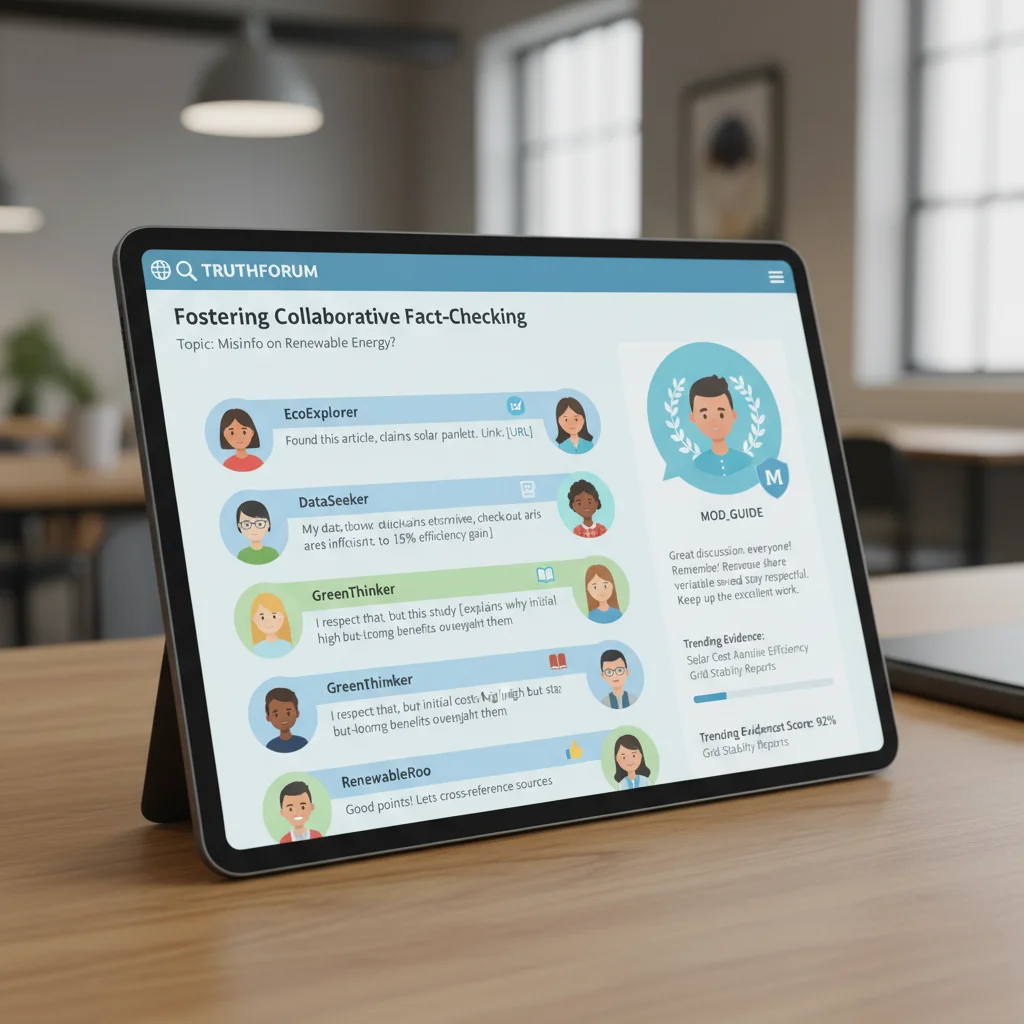
Another powerful approach in combat misinformation strategies involves fostering collaborative fact-checking initiatives within online communities. While professional fact-checkers play an indispensable role, the sheer volume of misinformation necessitates a distributed, community-driven effort. By 2026, we should see a proliferation of user-driven fact-checking tools and platforms that empower ordinary citizens to participate in verifying information.
These initiatives can take various forms. One model involves creating dedicated community forums or groups focused on fact-checking specific topics or local news. Members can share suspicious content, collectively research its veracity using established fact-checking resources, and openly discuss their findings. The emphasis here is on transparency, peer review, and adherence to evidence-based methodologies. Platforms could integrate features that allow users to easily report potentially false information, which then gets routed to these community fact-checking hubs for review.
Gamification can also play a role in encouraging participation. Imagine online challenges where users earn points or badges for successfully identifying and debunking misinformation, or for contributing to the verification of complex claims. This not only makes the process more engaging but also helps to build a cohort of skilled and motivated community fact-checkers. Such systems would need careful design to prevent manipulation and ensure accuracy, perhaps by requiring multiple independent verifications for high-stakes claims.
The development of open-source tools that simplify the fact-checking process for the average user is also crucial. These tools could include browser extensions that flag known misinformation sources, reverse image search functionalities, or AI-powered assistants that help cross-reference claims with reliable databases. Making these tools intuitive and widely available would significantly lower the barrier to entry for community fact-checking, allowing more people to actively contribute to a more truthful online environment.
Platforms themselves have a responsibility to facilitate these collaborative efforts. This could mean providing designated spaces for community-led fact-checking, offering training resources on best practices, and even integrating community-verified labels directly into content feeds. The challenge lies in balancing user participation with the need for accuracy and preventing mob mentality or harassment. Clear guidelines, strong moderation, and transparent appeal processes would be essential for the success and credibility of such initiatives.
Ultimately, fostering collaborative fact-checking is about harnessing the collective intelligence of online communities. When individuals feel empowered to contribute to the truth, and when mechanisms are in place to support and validate their efforts, the spread of misinformation can be significantly curtailed. This strategy moves beyond a top-down approach, recognizing that the most effective way to combat a decentralized problem like misinformation is with a decentralized, community-driven solution, making it a cornerstone of effective combat misinformation strategies by 2026.
3. Promoting Ethical Sharing and Responsible Online Behavior
Beyond individual critical thinking and collective fact-checking, a key social strategy in combat misinformation strategies is the promotion of ethical sharing and responsible online behavior. Misinformation often spreads because users share content without due diligence, driven by emotional reactions or a desire to be the first to break news. By 2026, cultivating a culture of pause, reflection, and responsibility before sharing must be a widespread norm in US online communities.
This strategy involves educating users about the impact of their sharing habits. Every time someone shares unverified information, they contribute to its spread and legitimacy. Public awareness campaigns can highlight the ripple effect of sharing, illustrating how a single click can contribute to significant societal harm. These campaigns should use relatable examples and engage diverse demographics, emphasizing that responsible sharing is a civic duty in the digital age.
Social media platforms can actively encourage this responsible behavior through design interventions. For example, implementing prompts that ask users, “Are you sure you want to share this without reading it?” or “Do you know the source of this information?” before they hit the share button. Such friction points, even if minor, can encourage a moment of reflection. Similarly, making it easier for users to find original sources or fact-checks related to a piece of content before they share it can significantly reduce the spread of false narratives.
Furthermore, promoting empathy and understanding in online interactions is crucial. Misinformation often thrives in environments of polarization and hostility. By fostering respectful dialogue, encouraging constructive disagreement, and emphasizing shared values, online communities can become less susceptible to divisive and misleading content. This involves promoting digital etiquette and discouraging personal attacks, ensuring that discussions remain focused on facts and evidence rather than ad hominem arguments.
Influencers and community leaders also have a significant role to play. By modeling responsible sharing practices, openly discussing their own verification processes, and using their platforms to promote critical thinking, they can inspire their followers to adopt similar habits. Platforms could even recognize and amplify users who consistently demonstrate ethical sharing and contribute positively to information hygiene, creating positive reinforcement for desired behaviors.
Teaching users about the commercial and political motivations behind misinformation is also part of promoting ethical sharing. Understanding that some content is designed to manipulate opinions for profit or power can make individuals more skeptical and less likely to inadvertently become tools in the spread of propaganda. This awareness empowers users to not just question the content itself, but also the intent behind its creation and dissemination.
Ultimately, promoting ethical sharing is about shifting the default behavior from impulsive sharing to thoughtful consideration. It’s about instilling a sense of personal accountability for the information we disseminate online. By 2026, through a combination of education, platform design, and community leadership, we can aspire to a digital environment where responsible online behavior is the norm, significantly strengthening our collective combat misinformation strategies.
4. Strengthening Community Moderation and Platform Accountability
Effective combat misinformation strategies require robust community moderation and increased platform accountability. While user-driven initiatives are vital, the sheer scale of online content means that platforms themselves must step up their efforts to create safer and more truthful environments. By 2026, there should be a significant advancement in how online platforms in the US approach content moderation, moving towards proactive and transparent systems.
Firstly, platform investment in human moderation needs to be dramatically increased. While AI tools can assist in identifying potentially harmful content, human judgment remains indispensable for nuanced decision-making, especially concerning complex misinformation. These moderation teams should be diverse, well-trained, and culturally competent to understand the varied contexts in which misinformation manifests across different US communities. They also need adequate support and resources to prevent burnout and ensure consistent application of policies.
Transparency in moderation practices is equally critical. Platforms should clearly articulate their content policies regarding misinformation, explain how moderation decisions are made, and provide clear avenues for users to appeal decisions. This transparency builds trust and helps users understand the boundaries of acceptable online discourse. Regular reports on the volume of misinformation detected and removed, along with the effectiveness of various strategies, can also hold platforms accountable and inform public discourse.
Furthermore, platforms must be held more accountable for the amplification of misinformation. Algorithms designed to maximize engagement can inadvertently prioritize sensational or emotionally charged content, which often includes misinformation. Developing and implementing algorithms that prioritize accuracy, source credibility, and thoughtful discourse over mere virality is a crucial step. This might involve re-evaluating metrics of success and designing systems that reward truthful and constructive contributions.
Collaboration between platforms, governments, and civil society organizations is also essential. This includes sharing best practices, developing common standards for identifying and addressing misinformation, and coordinating efforts to counter large-scale disinformation campaigns. Regulatory frameworks that incentivize responsible platform behavior, without stifling free speech, could also play a role in pushing platforms towards greater accountability. The goal is not censorship, but rather ensuring that platforms do not unwittingly become conduits for harm.
Community moderation, where trusted members of a community are empowered to help manage content, can supplement professional moderation. These community moderators, often volunteers, possess deep contextual understanding and can quickly identify content that violates community guidelines or spreads local misinformation. Platforms need to provide these community leaders with the necessary tools, training, and support to perform their roles effectively and fairly.
In conclusion, strengthening community moderation and platform accountability is about creating a symbiotic relationship between platforms and their users. Platforms provide the infrastructure and resources, while users contribute to a healthy information ecosystem. By 2026, a more responsible and accountable online environment, where misinformation struggles to find a foothold, should be a tangible reality, largely due to these concerted combat misinformation strategies.
5. Supporting Independent Journalism and Fact-Checking Organizations
The fifth, and arguably most critical, social strategy in combat misinformation strategies is the robust support for independent journalism and fact-checking organizations. These entities serve as the frontline defense against false narratives, providing credible, evidence-based information that is essential for a functioning democracy and an informed public. By 2026, significant efforts must be made to strengthen their capacity, reach, and financial sustainability across the US.
Independent journalism, particularly local journalism, often suffers from underfunding and dwindling resources, yet it is precisely these outlets that are best positioned to report on local issues where misinformation can have immediate and tangible impacts. Supporting these organizations through grants, philanthropic initiatives, and innovative business models is crucial. This includes investing in investigative journalism that uncovers the sources and motivations behind disinformation campaigns.
Fact-checking organizations are specialized entities dedicated to verifying claims made in public discourse. They employ rigorous methodologies to assess the accuracy of statements, often publishing their findings with detailed explanations and evidence. These organizations are indispensable in the fight against misinformation. Support for them should include funding for research, technological development (e.g., AI tools for faster verification), and expansion of their reach to cover more languages and platforms.
Collaboration between platforms and fact-checkers is also vital. Social media companies should continue and expand partnerships with accredited fact-checking organizations, allowing them to review and label content that falls below accuracy standards. This not only helps to flag misinformation but also provides users with direct access to verified information. However, these partnerships must maintain the independence of fact-checkers, ensuring their editorial autonomy and preventing any perception of bias.
Public awareness of and trust in these independent institutions must also be cultivated. Campaigns that educate the public about the role of journalists and fact-checkers, how they operate, and why their work is important can help build greater appreciation for credible information. Teaching media literacy in schools, as discussed earlier, should include an understanding of the journalistic process and the importance of supporting quality news sources.
Innovations in funding models are also necessary. Subscription models, reader donations, and philanthropic support can help reduce reliance on advertising revenue, which can sometimes create perverse incentives. Exploring models where platforms contribute to a fund that supports independent journalism and fact-checking, perhaps proportional to their market share or the volume of content they host, could also be a viable path forward.
Ultimately, a healthy information ecosystem depends on the strength and vitality of its independent watchdogs. By strategically supporting independent journalism and fact-checking organizations, we are investing in the very infrastructure of truth. By 2026, these efforts should ensure that these critical institutions are robust, resilient, and capable of effectively countering the persistent deluge of misinformation, thereby solidifying our combat misinformation strategies.
Conclusion: A Collective Path to a More Informed Online Future
The challenge of misinformation in US online communities is multifaceted and deeply entrenched, but not insurmountable. The five social strategies outlined – empowering digital literacy, fostering collaborative fact-checking, promoting ethical sharing, strengthening community moderation and platform accountability, and supporting independent journalism and fact-checking organizations – represent a comprehensive and synergistic approach to combat misinformation strategies by 2026.
Each of these strategies plays a distinct yet interconnected role. Digital literacy equips individuals with the foundational skills to critically assess information. Collaborative fact-checking leverages collective intelligence to verify claims at scale. Ethical sharing cultivates responsible online behavior, slowing the spread of false narratives. Robust moderation and platform accountability ensure that the digital environment itself is designed to discourage misinformation. And finally, supporting independent journalism and fact-checking provides the essential bedrock of credible information against which all other claims can be measured.
Achieving a significant reduction in the impact of misinformation by 2026 will require a concerted, collaborative effort from all stakeholders: individuals, educators, community leaders, technology platforms, journalists, and policymakers. It demands a shift in mindset, from passively consuming information to actively engaging with it, questioning its veracity, and understanding its provenance. It also necessitates a commitment to continuous learning and adaptation, as the tactics of those who spread misinformation are constantly evolving.
The benefits of successfully implementing these strategies extend far beyond merely reducing the prevalence of false information. A more informed and critically thinking populace is better equipped to make sound decisions in all aspects of life – from personal health choices to civic participation. It fosters healthier public discourse, strengthens democratic processes, and bolsters social cohesion by building trust in shared facts and respectful dialogue.
As we move towards 2026, let us embrace these social strategies not as mere suggestions, but as urgent imperatives. The future of our online communities, and indeed, the health of our society, depends on our collective ability to cultivate an environment where truth can flourish, critical thinking is celebrated, and misinformation finds no fertile ground. By working together, we can build a digital landscape that truly serves to inform, connect, and empower every individual in the United States.
Emilly Correa has a degree in journalism and a postgraduate degree in Digital Marketing, specializing in Content Production for Social Media. With experience in copywriting and blog management, she combines her passion for writing with digital engagement strategies. She has worked in communications agencies and now dedicates herself to producing informative articles and trend analyses.