Cloud Security 2026: Hybrid Cloud Action Plan US

The landscape of enterprise IT is continuously evolving, with hybrid cloud environments becoming the de facto standard for many organizations in the United States. This architectural model, combining on-premises infrastructure with public and private cloud services, offers unparalleled flexibility, scalability, and cost efficiency. However, this inherent complexity also introduces a myriad of security challenges. As we rapidly approach 2026, the need for a robust and proactive hybrid cloud security strategy is no longer a luxury but a critical imperative for business continuity, data protection, and regulatory compliance.
In the US, the regulatory environment is particularly intricate, with a patchwork of federal and state-specific laws such as HIPAA, GDPR (for US entities handling EU data), CCPA/CPRA, and various industry-specific mandates. These regulations often impose stringent requirements on data residency, privacy, and security, making an effective hybrid cloud security posture indispensable. Furthermore, the sophistication of cyber threats continues to escalate, with adversaries constantly developing new techniques to exploit vulnerabilities across distributed infrastructures. From ransomware and phishing to advanced persistent threats (APTs) and supply chain attacks, the threat surface for hybrid cloud environments is expansive and dynamic.
This article presents a practical, 3-month action plan designed specifically for US organizations to fortify their hybrid cloud security defenses by 2026. This plan is structured to provide actionable steps, enabling IT and security teams to systematically assess, improve, and maintain a secure hybrid cloud ecosystem. We will delve into critical areas such as risk assessment, identity and access management, data protection, network security, compliance, and incident response, offering a roadmap to navigate the complexities of modern cloud security.
The goal is to move beyond reactive security measures and build a resilient framework that anticipates future threats and regulatory changes. By the end of this 3-month journey, organizations should have a significantly enhanced security posture, a clearer understanding of their hybrid cloud risks, and a sustainable strategy for ongoing security management. Let’s embark on this crucial mission to secure your hybrid cloud environment for the challenges and opportunities of 2026 and beyond.
Month 1: Foundation and Assessment for Robust Hybrid Cloud Security
The first month of our 3-month action plan is dedicated to laying a strong foundation for hybrid cloud security. This involves a thorough assessment of your current environment, understanding existing vulnerabilities, and defining the scope of your security initiatives. Without a clear picture of your current state, any subsequent security efforts risk being misdirected or incomplete.
Week 1: Comprehensive Hybrid Cloud Asset Inventory and Risk Assessment
The initial step is to gain complete visibility into your hybrid cloud ecosystem. This means identifying all assets, both on-premises and in the cloud, that form part of your hybrid infrastructure. This includes virtual machines, containers, serverless functions, storage accounts, databases, network devices, and applications. For each asset, document its purpose, location, data classification (e.g., sensitive, public), ownership, and criticality to business operations.
- Asset Discovery: Utilize automated tools for discovery across all cloud providers (AWS, Azure, GCP, etc.) and your on-premises data centers. Integrate with existing CMDBs (Configuration Management Database) where possible.
- Data Mapping and Classification: Identify where sensitive data resides within your hybrid cloud. Categorize data based on its confidentiality, integrity, and availability requirements. This is crucial for applying appropriate security controls and adhering to US-specific data privacy regulations.
- Risk Assessment Framework: Establish a standardized risk assessment methodology. This should involve identifying potential threats (e.g., unauthorized access, data breaches, DDoS attacks), assessing vulnerabilities (e.g., misconfigurations, unpatched systems), and evaluating the likelihood and impact of these risks. Prioritize risks based on their potential to disrupt business operations or cause regulatory non-compliance.
- Stakeholder Identification: Identify key stakeholders from IT, security, legal, compliance, and business units who will be involved in the hybrid cloud security initiative. Define their roles and responsibilities.
Week 2: Policy Review, Gap Analysis, and Compliance Mapping
With a clear understanding of your assets and risks, the next step is to review your existing security policies and identify gaps. This week focuses on aligning your security posture with relevant US regulations and industry best practices.
- Current Policy Review: Examine existing security policies related to data handling, access control, incident response, and acceptable use. Determine if they adequately address the unique challenges of a hybrid cloud environment.
- Compliance Requirements Mapping: Identify all relevant US compliance mandates (e.g., HIPAA for healthcare, PCI DSS for payment processing, NIST CSF for federal agencies, CCPA/CPRA for California consumer data, NYDFS for financial services in New York). Map these requirements to your current security controls and identify areas of non-compliance.
- Gap Analysis: Conduct a thorough gap analysis between your current security state, your desired future state, and the compliance requirements. This will highlight critical areas where new controls or policy updates are needed.
- Cloud Service Provider (CSP) Shared Responsibility Model Understanding: Ensure a clear understanding of the shared responsibility model for each cloud provider you use. Document what security responsibilities lie with your organization and what is managed by the CSP. This is a common area of misunderstanding and a significant source of vulnerabilities in hybrid cloud security.
Week 3: Identity and Access Management (IAM) Audit and Consolidation
Identity and Access Management (IAM) is the cornerstone of any effective security strategy, especially in complex hybrid environments. This week focuses on auditing and consolidating your IAM practices.
- IAM Audit: Review all user accounts, roles, and permissions across your on-premises directories (e.g., Active Directory) and cloud IAM systems. Identify dormant accounts, excessive privileges, and inconsistent access policies.
- Multi-Factor Authentication (MFA) Enforcement: Mandate MFA for all privileged accounts and, ideally, for all user accounts across both on-premises and cloud resources. This is a fundamental security control against credential theft.
- Principle of Least Privilege (PoLP): Implement and enforce the principle of least privilege, ensuring users and services only have the minimum necessary permissions to perform their tasks. Regularly review and revoke unnecessary permissions.
- Centralized IAM Strategy: Explore and plan for the implementation of a centralized IAM solution that can manage identities and access across your entire hybrid cloud. This could involve extending your on-premises Active Directory to the cloud or adopting a cloud-native identity provider with hybrid capabilities.
- Access Reviews: Schedule regular access reviews to ensure that permissions remain appropriate as roles and responsibilities change.
Week 4: Network Security Review and Segmentation Planning
Network security forms the perimeter defense for your hybrid cloud. This week focuses on reviewing existing network controls and planning for robust segmentation.
- Network Topology Mapping: Create a detailed map of your hybrid cloud network topology, including VPNs, direct connects, virtual networks, subnets, and security groups.
- Firewall and Security Group Configuration Review: Audit firewall rules and cloud security group configurations for both ingress and egress traffic. Identify overly permissive rules, unnecessary open ports, and potential misconfigurations.
- Network Segmentation Strategy: Develop a comprehensive network segmentation strategy for your hybrid environment. This involves logically dividing your network into smaller, isolated segments based on function, data sensitivity, or application. Micro-segmentation within cloud environments should also be considered to limit lateral movement of threats.
- DNS Security: Review your DNS infrastructure for vulnerabilities and implement security measures such as DNSSEC (DNS Security Extensions) where appropriate.
- DDoS Protection: Ensure robust DDoS protection mechanisms are in place for public-facing applications and services, leveraging cloud provider capabilities and specialized services.
Month 2: Implementation and Enhancement of Hybrid Cloud Security Controls
Month two shifts from assessment and planning to the active implementation and enhancement of security controls identified in month one. This is where the practical improvements to your hybrid cloud security posture begin to take shape.
Week 5: Data Protection and Encryption Implementation
Protecting data at rest and in transit is paramount in a hybrid cloud. This week focuses on implementing encryption and data loss prevention (DLP) measures.
- Data Encryption at Rest: Implement encryption for all sensitive data stored in cloud storage (object storage, block storage, databases) and on-premises storage. Utilize cloud provider encryption services (KMS, Key Vault) and ensure proper key management.
- Data Encryption in Transit: Enforce encryption for all data transmitted between on-premises and cloud environments (e.g., VPNs, Direct Connects with IPSec) and between different cloud services (e.g., TLS/SSL for web traffic).
- Data Loss Prevention (DLP) Strategy: Develop and begin implementing a DLP strategy to prevent sensitive data from leaving your hybrid cloud environment. This may involve deploying DLP solutions at network egress points, email gateways, and endpoint protection.
- Data Backup and Recovery: Review and enhance your data backup and disaster recovery plans. Ensure backups are encrypted, regularly tested, and stored in geographically diverse locations, adhering to US data residency requirements.
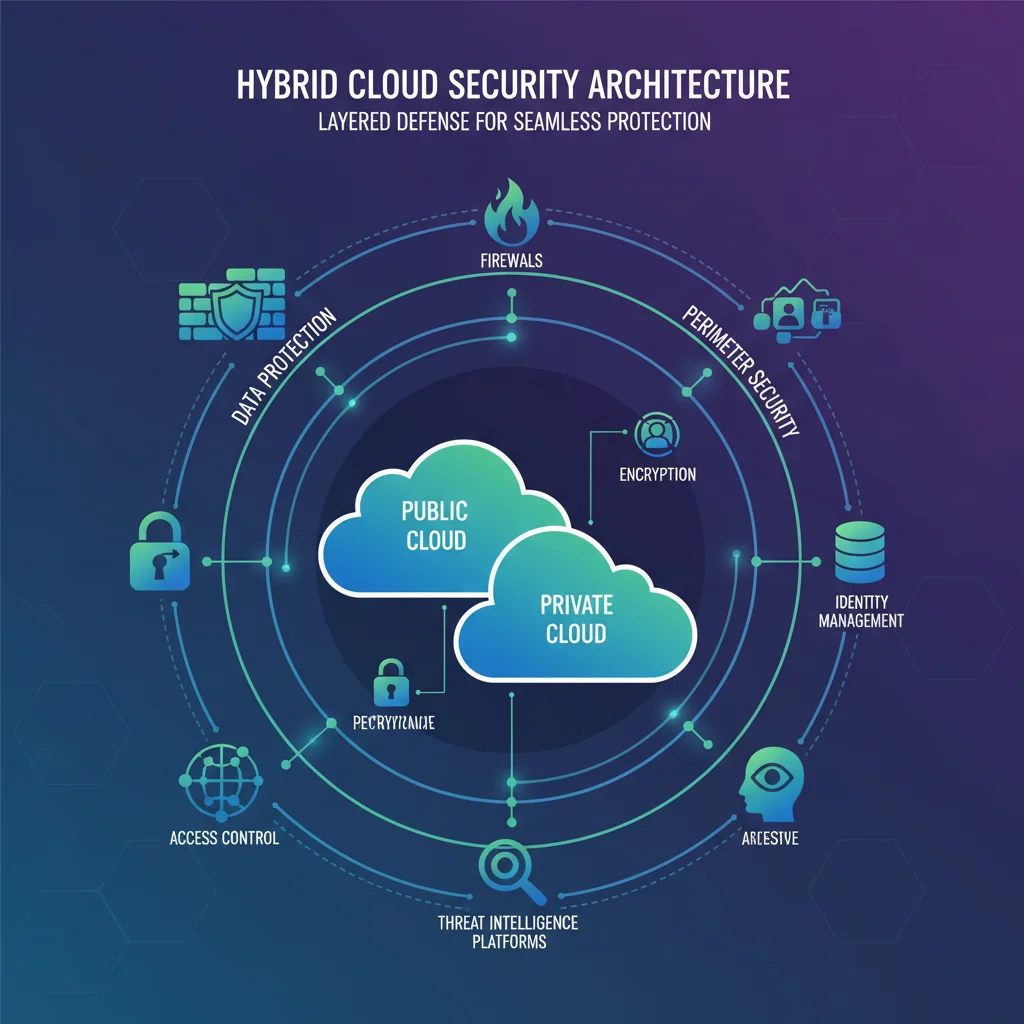
Week 6: Cloud Security Posture Management (CSPM) and Cloud Workload Protection Platform (CWPP) Deployment
Automating security posture management and workload protection is crucial for maintaining effective hybrid cloud security at scale.
- CSPM Tool Deployment: Deploy a Cloud Security Posture Management (CSPM) solution to continuously monitor your cloud configurations for misconfigurations, compliance violations, and security risks. Configure alerts for critical deviations.
- CWPP Implementation: Implement a Cloud Workload Protection Platform (CWPP) to secure your virtual machines, containers, and serverless functions across your hybrid environment. This includes vulnerability management, runtime protection, and integrity monitoring.
- Security Baselines: Define and enforce security baselines for all cloud resources and on-premises servers. Use CSPM and CWPP tools to automatically identify and remediate deviations from these baselines.
- Vulnerability Management Integration: Integrate your CSPM and CWPP tools with your existing vulnerability management program to ensure a unified view of vulnerabilities across your hybrid infrastructure.
Week 7: Network Segmentation and API Security Hardening
Building on the planning from Week 4, this week focuses on actively implementing network segmentation and securing APIs, which are often overlooked attack vectors.
- Implement Network Segmentation: Actively implement the planned network segmentation using virtual networks, subnets, Network ACLs, security groups, and possibly micro-segmentation solutions across your hybrid cloud. Isolate critical applications and data stores.
- API Security Gateway: Deploy an API Gateway to manage and secure all API traffic. Implement API authentication, authorization, rate limiting, and input validation to protect against common API attacks.
- API Inventories and Audits: Maintain a comprehensive inventory of all APIs used in your hybrid environment, both internal and external. Regularly audit API configurations and access patterns.
- Web Application Firewall (WAF) Deployment: Deploy WAFs in front of all public-facing web applications, both on-premises and in the cloud, to protect against common web exploits (e.g., SQL injection, cross-site scripting).
Week 8: Security Information and Event Management (SIEM) / Security Orchestration, Automation, and Response (SOAR) Integration
Centralized logging, monitoring, and automated response capabilities are vital for detecting and responding to threats in real-time within a complex hybrid cloud security environment.
- Centralized Logging: Aggregate logs from all cloud services, on-premises infrastructure, security devices (firewalls, WAFs), and applications into a centralized SIEM solution. Ensure all relevant security events are captured.
- SIEM Configuration and Alerting: Configure your SIEM to correlate events, detect anomalies, and generate actionable alerts for potential security incidents. Define clear alerting thresholds and escalation paths.
- SOAR Integration Planning: Begin planning for or integrating SOAR capabilities to automate incident response workflows. This can include automated blocking of malicious IPs, quarantining compromised systems, or triggering human alerts.
- Threat Intelligence Feeds: Integrate reputable threat intelligence feeds into your SIEM and other security tools to enhance threat detection capabilities and provide context to alerts.
- Security Monitoring Dashboards: Develop comprehensive security monitoring dashboards to provide real-time visibility into the security posture of your hybrid cloud.
Month 3: Optimization, Training, and Sustained Hybrid Cloud Security Operations
The final month focuses on refining your security posture, ensuring operational readiness, and establishing a continuous improvement cycle for your hybrid cloud security program.
Week 9: Incident Response Plan Development and Tabletop Exercises
Even with the best preventative measures, incidents can occur. A well-defined and tested incident response plan is critical for minimizing damage and ensuring swift recovery.
- Incident Response Plan (IRP) Development/Refinement: Develop or refine your IRP to specifically address hybrid cloud incidents. Clearly define roles, responsibilities, communication protocols, and escalation procedures for various types of incidents (e.g., data breach, ransomware, denial of service).
- Playbook Creation: Create detailed playbooks for common hybrid cloud security incidents, outlining step-by-step actions for detection, containment, eradication, recovery, and post-incident analysis.
- Tabletop Exercises: Conduct tabletop exercises with your incident response team and key stakeholders. Simulate various hybrid cloud security scenarios to test the effectiveness of your IRP and identify areas for improvement. This is crucial for practical preparedness.
- Communication Strategy: Define internal and external communication strategies for security incidents, including legal counsel, regulatory bodies (e.g., CISA, state attorneys general), and affected customers, especially considering US breach notification laws.
Week 10: Security Awareness Training and Policy Enforcement
Human error remains a leading cause of security breaches. Investing in comprehensive security awareness training and ensuring policy adherence is vital.
- Targeted Security Awareness Training: Develop and deliver tailored security awareness training programs for all employees, focusing on hybrid cloud specific risks such as phishing, social engineering, secure coding practices (for developers), and data handling policies.
- Privileged User Training: Provide specialized training for privileged users and IT staff on secure administration practices, cloud console security, and incident detection.
- Policy Enforcement and Review: Communicate and enforce updated security policies. Establish mechanisms for regular policy review and updates to keep pace with evolving threats and regulatory changes.
- Security Champion Program: Consider establishing a security champion program where employees from different departments advocate for security best practices within their teams.

Week 11: Penetration Testing, Vulnerability Scanning, and Red Teaming
Proactive testing of your security controls is essential to identify weaknesses before adversaries do. This week focuses on ethical hacking and vulnerability assessment.
- Regular Vulnerability Scanning: Implement continuous vulnerability scanning across your entire hybrid cloud environment, including network devices, servers, applications, and cloud configurations.
- Penetration Testing: Engage third-party security experts to conduct penetration tests specifically targeting your hybrid cloud environment. This should include both external and internal penetration tests to simulate real-world attack scenarios.
- Cloud Configuration Audits: Perform regular, in-depth audits of your cloud configurations, separate from automated CSPM, to catch subtle misconfigurations that might be missed.
- Red Teaming Exercises (Optional but Recommended): For more mature organizations, conduct red teaming exercises to simulate sophisticated attacks against your hybrid cloud, testing not only your technical controls but also your people and processes.
- Remediation Prioritization: Establish a clear process for prioritizing and remediating identified vulnerabilities and findings from penetration tests based on risk level.
Week 12: Continuous Improvement and Governance for Hybrid Cloud Security
The final week is about establishing a sustainable framework for ongoing hybrid cloud security management and continuous improvement. Security is not a one-time project but an ongoing process.
- Security Governance Framework: Formalize your security governance framework, including a security committee, regular reporting mechanisms to leadership, and clear accountability for security outcomes.
- Key Performance Indicators (KPIs) and Metrics: Define relevant security KPIs and metrics to measure the effectiveness of your hybrid cloud security program (e.g., mean time to detect, mean time to respond, number of critical vulnerabilities, compliance scores).
- Regular Review and Audit Schedule: Establish a schedule for regular reviews of security policies, controls, and compliance posture. Plan for annual or bi-annual third-party audits.
- Threat Landscape Monitoring: Implement a process for continuously monitoring the evolving threat landscape, new vulnerabilities, and changes in US regulatory requirements.
- Budgeting and Resource Allocation: Ensure adequate budget and resources are allocated for ongoing security tools, training, personnel, and future security initiatives.
- Feedback Loop: Create a feedback loop where lessons learned from incidents, audits, and new threats are incorporated back into your security strategy and operational procedures.
Key Considerations for US Hybrid Cloud Environments
Beyond the general action plan, several specific considerations are particularly relevant for US organizations operating hybrid clouds:
- Data Residency and Sovereignty: Carefully evaluate where your data resides, especially sensitive customer data. US federal and state laws may mandate data to remain within specific geographic boundaries. Ensure your cloud providers offer regions within the US and that your hybrid architecture respects these requirements.
- Federal and State Compliance: Stay abreast of evolving compliance mandates. CCPA/CPRA, HIPAA, Sarbanes-Oxley (SOX), and various state-specific data breach notification laws all have implications for your hybrid cloud security. Consider engaging legal counsel to ensure full compliance.
- Vendor Risk Management: In a hybrid environment, you rely on multiple cloud service providers and third-party vendors. Implement a robust vendor risk management program to assess the security posture of all your partners. This includes reviewing their SOC 2 reports, security certifications, and contractual agreements.
- Supply Chain Security: The increasing prevalence of supply chain attacks (e.g., SolarWinds) necessitates a focus on the security of all software and services integrated into your hybrid cloud. Implement secure software development lifecycles (SSDLC) and vet third-party components.
- Cloud Native Security Services: Leverage the native security services offered by your cloud providers (AWS Security Hub, Azure Security Center, GCP Security Command Center). These can significantly enhance your detection and response capabilities and simplify compliance.
- Zero Trust Architecture: Consider adopting a Zero Trust security model, which assumes no user or device can be trusted by default, regardless of whether they are inside or outside the network perimeter. This approach is highly effective for complex hybrid environments.
Conclusion: Securing Your Hybrid Cloud for 2026 and Beyond
The journey to a truly secure hybrid cloud environment is continuous, but this 3-month action plan provides a structured and actionable roadmap for US organizations to significantly enhance their hybrid cloud security posture by 2026. By focusing on foundational assessments, strategic implementations, and ongoing optimization, you can build a resilient defense against the ever-evolving threat landscape.
Remember that effective security is not just about technology; it’s about people and processes. Investing in your security team’s skills, fostering a culture of security awareness, and establishing clear governance are equally important as deploying the latest security tools. The complexity of hybrid cloud demands a holistic and integrated approach to security.
By diligently following the steps outlined in this plan, US organizations can confidently navigate the challenges of the digital age, protect their valuable assets, maintain regulatory compliance, and ensure business continuity in their hybrid cloud environments. Start today, and secure your future in the cloud.
Related Posts: