Edge AI Adoption 2026: A Critical Platform Comparison for US Manufacturing
The landscape of US manufacturing is undergoing a profound transformation, driven by the relentless march of technological innovation. At the forefront of this revolution is Artificial Intelligence (AI), and more specifically, Edge AI. As we look towards 2026, the adoption of Edge AI platforms is no longer a futuristic concept but a strategic imperative for manufacturers seeking to maintain a competitive edge, enhance operational efficiency, and drive unprecedented levels of innovation. This comprehensive guide delves into the nuances of Edge AI, its significance for US manufacturing, and a detailed comparison of the leading platforms poised to dominate the market in the coming years.
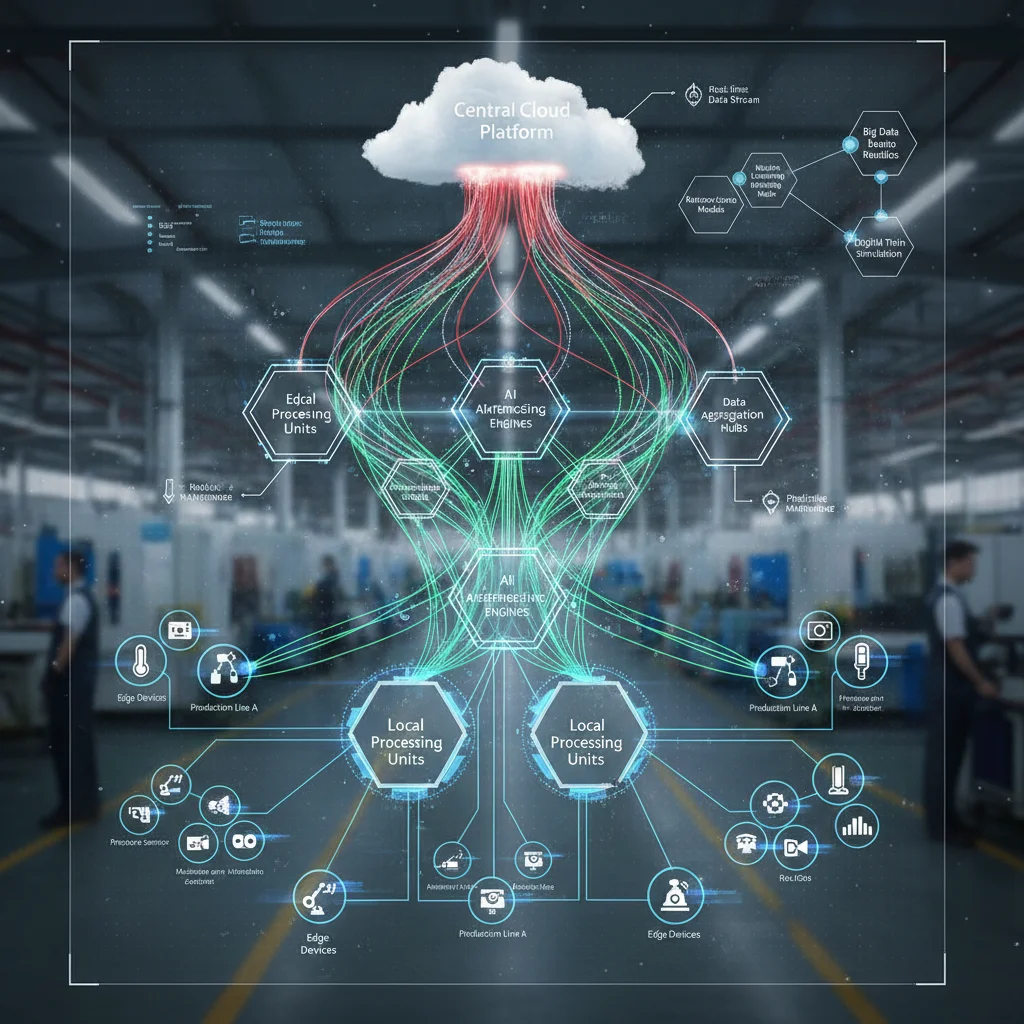
The promise of Edge AI lies in its ability to process data closer to its source – the ‘edge’ of the network – rather than relying solely on centralized cloud infrastructure. This localized processing offers numerous benefits, including reduced latency, enhanced security, lower bandwidth consumption, and the ability to operate in environments with intermittent connectivity. For a sector like manufacturing, where real-time decision-making, predictive maintenance, quality control, and automation are paramount, these advantages translate directly into tangible improvements in productivity and profitability. Understanding the various Edge AI platforms available and their specific strengths and weaknesses is crucial for making informed investment decisions.
The Imperative of Edge AI in US Manufacturing
US manufacturing faces a unique set of challenges and opportunities. Global competition, supply chain complexities, labor shortages, and the increasing demand for customized products necessitate agile, intelligent, and highly automated production processes. Edge AI directly addresses many of these challenges:
- Real-time Decision Making: Traditional cloud-based AI can introduce latency, which is unacceptable for applications requiring immediate responses, such as robotic control, anomaly detection on assembly lines, or real-time quality inspections. Edge AI enables instantaneous analysis and action, preventing costly errors and downtime.
- Enhanced Security and Privacy: Processing sensitive operational data at the edge reduces the need to transmit it to the cloud, thereby minimizing exposure to cyber threats and addressing data privacy concerns. This is particularly vital for intellectual property and proprietary manufacturing processes.
- Optimized Bandwidth Usage: Manufacturing facilities often generate vast amounts of data from thousands of sensors and devices. Sending all this raw data to the cloud for processing is often impractical and expensive. Edge AI filters, processes, and analyzes data locally, sending only critical insights to the cloud, significantly reducing bandwidth requirements.
- Operational Resilience: Edge AI systems can continue to function even if internet connectivity to the cloud is interrupted. This local autonomy ensures continuous operation, which is critical for maintaining production schedules and avoiding costly stoppages.
- Scalability and Flexibility: Deploying AI models at the edge allows manufacturers to scale their intelligent operations incrementally, adding AI capabilities to specific machines or production lines as needed, without overhauling their entire IT infrastructure. This flexibility is key for adapting to changing market demands and technological advancements.
The strategic implementation of Edge AI platforms is not just about adopting new technology; it’s about fundamentally rethinking how manufacturing operations are managed, optimized, and innovated. It’s about empowering machines with intelligence, enabling proactive problem-solving, and unlocking new levels of efficiency that were previously unattainable.
Key Considerations When Choosing Edge AI Platforms
Selecting the right Edge AI platform is a complex decision that requires careful consideration of various factors specific to a manufacturer’s needs and existing infrastructure. Here are some critical aspects to evaluate:
Hardware Compatibility and Performance
Edge AI relies heavily on specialized hardware capable of executing AI workloads efficiently at the edge. This includes:
- Edge Devices: From industrial PCs and embedded systems to specialized AI accelerators (GPUs, NPUs, FPGAs), the platform should support a range of hardware options suitable for rugged industrial environments.
- Processing Power: The ability to handle complex AI models (e.g., computer vision for quality inspection, machine learning for predictive maintenance) with low latency is paramount.
- Power Efficiency: Many edge deployments require low-power solutions, especially for remote or battery-operated sensors.
Software Ecosystem and Development Tools
A robust software ecosystem is vital for developing, deploying, and managing AI models at the edge. Key features include:
- Model Development and Training: Integration with popular AI/ML frameworks (TensorFlow, PyTorch, ONNX) and tools for model optimization and quantization for edge deployment.
- Deployment and Orchestration: Capabilities for remotely deploying, updating, and managing AI models across a fleet of edge devices. Containerization technologies (Docker, Kubernetes) are often central here.
- Data Management: Tools for collecting, preprocessing, and securely storing data at the edge, as well as for intelligently sending relevant data to the cloud.
- APIs and SDKs: Well-documented APIs and SDKs facilitate integration with existing operational technology (OT) and IT systems.
Connectivity and Interoperability
Edge devices rarely operate in isolation. The platform must support various connectivity options and seamlessly integrate with other systems:
- Protocols: Support for industrial communication protocols (e.g., Modbus, OPC UA, MQTT) and standard networking protocols (5G, Wi-Fi, Ethernet).
- Cloud Integration: Seamless integration with major cloud providers (AWS, Azure, Google Cloud) for hybrid AI architectures, where some processing happens at the edge and some in the cloud.
- Legacy Systems: Ability to connect with and extract data from older machinery and control systems.
Security and Compliance
Security is non-negotiable in manufacturing environments:
- Device Security: Secure boot, hardware-level encryption, and robust authentication mechanisms for edge devices.
- Data Security: Encryption of data at rest and in transit, access control, and auditing capabilities.
- Compliance: Adherence to industry-specific regulations and data governance standards.
Scalability and Manageability
As Edge AI deployments grow, managing them effectively becomes critical:
- Remote Management: Centralized management consoles for monitoring device health, deploying updates, and troubleshooting issues across geographically dispersed sites.
- Scalability: The ability to easily add new devices and AI applications without significant overhead.
- Monitoring and Analytics: Tools for performance monitoring, logging, and generating insights from edge operations.
Leading Edge AI Platforms for US Manufacturing in 2026: A Comparison
The market for Edge AI platforms is dynamic, with established tech giants and innovative startups vying for market share. Here’s a look at some of the prominent players and their offerings, crucial for US manufacturers making strategic choices for 2026:
1. AWS IoT Greengrass
- Overview: AWS IoT Greengrass extends AWS cloud capabilities to edge devices, allowing local execution of AWS Lambda functions, data synchronization, and machine learning inference. It’s part of a broader AWS IoT ecosystem.
- Strengths: Deep integration with AWS cloud services (S3, SageMaker, Lambda), extensive developer tools, strong security features, and a mature ecosystem. Ideal for manufacturers already invested in AWS.
- Weaknesses: Can have a steeper learning curve for those unfamiliar with the AWS ecosystem. Cost can scale with usage, requiring careful management.
- Manufacturing Relevance: Excellent for predictive maintenance, quality control (using computer vision models from SageMaker), asset tracking, and optimizing industrial processes by leveraging cloud-trained models at the edge.
2. Microsoft Azure IoT Edge
- Overview: Azure IoT Edge brings cloud intelligence and analytics to edge devices, allowing organizations to deploy AI, Azure services, and custom logic directly to industrial equipment.
- Strengths: Seamless integration with Azure cloud services, support for various AI frameworks (TensorFlow, PyTorch), robust security, and comprehensive device management capabilities. Offers good hybrid cloud options.
- Weaknesses: Similar to AWS, a learning curve for new users of the Azure ecosystem.
- Manufacturing Relevance: Strong for real-time anomaly detection, intelligent automation, remote monitoring of machinery, and integrating AI into existing factory systems using Azure’s extensive industrial IoT connectors.
3. Google Cloud IoT Edge / Anthos for Edge
- Overview: Google Cloud’s offerings, particularly Anthos for Edge, aim to extend Google Cloud’s infrastructure and services to edge locations, enabling consistent development and operations across cloud and edge.
- Strengths: Leverages Google’s expertise in AI/ML (TensorFlow, Google AI Platform), strong containerization (Kubernetes) and open-source contributions, and robust global infrastructure.
- Weaknesses: Anthos can be complex to set up and manage for smaller deployments; the edge offering is still evolving compared to more mature IoT platforms.
- Manufacturing Relevance: Ideal for manufacturers looking for advanced AI capabilities, particularly in computer vision for defect detection, predictive analytics, and deploying AI models at scale using Kubernetes orchestration.
4. NVIDIA Jetson Platform
- Overview: While not a full software platform in the same vein as AWS or Azure, NVIDIA’s Jetson platform provides powerful embedded computing boards and a comprehensive software stack (JetPack SDK) optimized for AI at the edge.
- Strengths: Unmatched performance for AI inference (especially deep learning and computer vision), robust developer community, extensive libraries, and tools.
- Weaknesses: Primarily a hardware-centric solution; requires integration with other software platforms for complete end-to-end management. Can be more resource-intensive than other edge devices.
- Manufacturing Relevance: Critical for advanced visual inspection, robotic guidance, autonomous mobile robots (AMRs), and any application requiring high-performance AI inference directly on the factory floor. Many Edge AI platforms leverage Jetson for their hardware layer.
5. Intel OpenVINO Toolkit
- Overview: OpenVINO (Open Visual Inference and Neural Network Optimization) is a free toolkit from Intel that optimizes deep learning models for inference on Intel hardware (CPUs, integrated GPUs, VPUs, FPGAs) at the edge.
- Strengths: Hardware agnostic (within Intel ecosystem), significant performance boosts for AI inference, open-source, and supports a wide range of pre-trained models.
- Weaknesses: Primarily focused on inference optimization; requires other tools for model training and full deployment orchestration.
- Manufacturing Relevance: Highly valuable for manufacturers using Intel-based industrial PCs and seeking to accelerate computer vision applications for quality control, assembly verification, and predictive maintenance without needing dedicated GPUs.
6. Siemens Industrial Edge
- Overview: Siemens Industrial Edge is specifically designed for industrial automation, bringing IT functionality to the shop floor. It allows users to run apps directly on Siemens controllers and industrial PCs, bridging the gap between OT and IT.
- Strengths: Deep integration with Siemens automation hardware (PLCs, HMIs), strong focus on industrial protocols and data sources, robust and reliable for harsh environments.
- Weaknesses: Primarily tied to the Siemens ecosystem, which might not suit manufacturers with diverse automation vendors.
- Manufacturing Relevance: Excellent for direct integration of AI into existing Siemens-controlled production lines, enabling real-time process optimization, condition monitoring, and intelligent control without complex external systems.
7. PTC Kepware/ThingWorx Edge
- Overview: PTC offers Kepware for industrial connectivity and ThingWorx for IoT application development, with edge capabilities to collect, aggregate, and process data close to the source.
- Strengths: Strong industrial connectivity (Kepware supports hundreds of protocols), robust platform for building IoT applications, and good visualization capabilities.
- Weaknesses: Can be a more proprietary ecosystem; licensing costs can be significant for large deployments.
- Manufacturing Relevance: Ideal for manufacturers needing to connect disparate industrial assets, normalize data, and build custom AI-powered applications for operational intelligence, asset performance management, and augmented reality (AR) support on the factory floor.
Implementing Edge AI: Best Practices for US Manufacturers
Beyond selecting the right Edge AI platforms, successful implementation requires a strategic approach:
Start Small, Think Big
Begin with pilot projects that address specific, high-value problems (e.g., a single production line for defect detection or predictive maintenance for a critical machine). This allows for learning and refinement before scaling across the entire operation.
Data Strategy is Key
Edge AI thrives on data. Develop a robust data strategy that includes data collection, cleaning, labeling, and management processes. Ensure data quality at the edge to feed accurate insights into AI models.
Integrate OT and IT
Successful Edge AI adoption requires close collaboration between Operational Technology (OT) and Information Technology (IT) teams. OT brings domain expertise in industrial processes, while IT provides the necessary infrastructure and cybersecurity knowledge. The chosen Edge AI platforms must facilitate this integration.
Cybersecurity First
Edge devices expand the attack surface. Implement comprehensive cybersecurity measures from the outset, including secure boot, encryption, access control, and regular security audits for all edge devices and software components.
Skill Development
Invest in training existing staff or hiring new talent with expertise in AI, data science, and industrial IoT. The success of Edge AI depends on the people who develop, deploy, and manage these systems.
Scalability and Future-Proofing
Choose Edge AI platforms that offer scalability and flexibility to accommodate future growth and technological advancements. The ability to update models remotely and integrate new hardware/software components seamlessly is crucial.
Consider Hybrid Approaches
Pure edge or pure cloud solutions are rare. Most manufacturers will benefit from a hybrid approach, where initial data processing and real-time inference occur at the edge, while more complex model training, long-term data storage, and aggregated analytics happen in the cloud. The best Edge AI platforms facilitate this hybrid architecture.
The Future of Edge AI in US Manufacturing
Looking ahead to 2026 and beyond, Edge AI is set to become an indispensable component of the modern US manufacturing ecosystem. The continuous evolution of AI algorithms, coupled with increasingly powerful and energy-efficient edge hardware, will unlock even more sophisticated applications. We can expect to see:
- Hyper-Personalization: Edge AI will enable real-time adaptation of production processes to meet highly individualized customer demands, leading to mass customization at scale.
- Autonomous Factories: Further advancements in Edge AI will pave the way for more autonomous operations, with robots and machines making complex decisions independently on the factory floor.
- Enhanced Human-Machine Collaboration: Edge AI will facilitate more intuitive and efficient collaboration between human workers and intelligent machines, augmenting human capabilities rather than replacing them entirely.
- Predictive and Prescriptive Maintenance 2.0: Moving beyond just predicting failures, Edge AI will offer prescriptive recommendations and even autonomously initiate corrective actions.
- Sustainable Manufacturing: Edge AI can optimize energy consumption, reduce waste, and improve resource utilization, contributing to more sustainable and environmentally friendly manufacturing practices.
The competitive landscape for Edge AI platforms will also intensify, leading to more specialized solutions tailored for specific industrial verticals and use cases. Open-source initiatives will continue to play a significant role in driving innovation and interoperability.
Conclusion
The journey towards full digital transformation in US manufacturing is complex, but the adoption of Edge AI platforms represents a monumental leap forward. By carefully evaluating the diverse offerings from industry leaders like AWS, Azure, Google Cloud, NVIDIA, Intel, Siemens, and PTC, manufacturers can select the platforms that best align with their strategic goals, technical capabilities, and operational requirements. The benefits – from increased efficiency and reduced costs to enhanced quality and greater agility – are too significant to ignore.
As 2026 approaches, the manufacturers who strategically invest in and effectively implement Edge AI will be the ones best positioned to thrive in an increasingly intelligent and interconnected industrial world. The time to assess, plan, and act on Edge AI adoption is now, ensuring that US manufacturing remains at the forefront of global innovation and competitiveness.