Edge AI Adoption 2026: Optimizing Data for US Enterprises – A 4-Step Guide

In the rapidly evolving landscape of digital transformation, Edge AI Adoption is no longer a futuristic concept but a present imperative for US enterprises aiming to maintain a competitive edge. As we approach 2026, the confluence of massive data generation, the demand for real-time insights, and advancements in AI technology is pushing computing power closer to the data source – the ‘edge’. This strategic shift promises unprecedented efficiency, enhanced security, and the ability to unlock new business models. However, successfully navigating the complexities of Edge AI Adoption requires a well-thought-out strategy. This comprehensive guide outlines a practical, 4-step approach to optimizing data processing for US enterprises, ensuring a smooth and impactful transition into the age of pervasive intelligence.
The Imperative of Edge AI Adoption for US Enterprises
The digital economy thrives on data. From smart factories and autonomous vehicles to retail analytics and intelligent healthcare, the volume and velocity of data being generated at the periphery of networks are staggering. Traditional cloud-centric architectures, while powerful, often struggle with the latency, bandwidth, and security demands of processing such vast amounts of data in real-time. This is where Edge AI Adoption steps in, offering a decentralized approach that brings AI capabilities directly to where the data is created.
For US enterprises, the benefits of embracing Edge AI are manifold. Consider a manufacturing plant: by deploying AI models on edge devices, predictive maintenance can be performed in real-time, identifying potential equipment failures before they occur, thus minimizing downtime and maximizing productivity. In retail, edge analytics can provide immediate insights into customer behavior, allowing for personalized experiences and optimized inventory management. Healthcare providers can leverage Edge AI for faster diagnostics and remote patient monitoring, improving outcomes and reducing costs. The strategic importance of Edge AI Adoption cannot be overstated; it’s about transforming raw data into actionable intelligence at the speed of business, fostering innovation, and securing a future-proof operational model.
The year 2026 is poised to be a pivotal moment for Edge AI Adoption, with significant technological advancements and a clearer understanding of its practical applications across various industries. Enterprises that start planning and implementing their Edge AI strategies now will be at the forefront of this revolution, gaining significant competitive advantages. This guide is designed to equip decision-makers with the knowledge and actionable steps needed to successfully integrate Edge AI into their existing infrastructures and future growth strategies.
Step 1: Assessing Your Enterprise’s Edge AI Readiness and Use Cases
The first critical step in successful Edge AI Adoption is a thorough assessment of your enterprise’s current infrastructure, data landscape, and identifying compelling use cases. Rushing into implementation without a clear understanding of your needs and capabilities can lead to costly mistakes and suboptimal outcomes. This phase requires a deep dive into your operational processes, existing data sources, and strategic objectives.
Current Infrastructure and Data Landscape Analysis
Begin by mapping out your current IT and operational technology (OT) infrastructure. Where is data currently being generated? What types of devices are involved (IoT sensors, cameras, industrial controllers, mobile devices)? What are the current data processing workflows? Evaluate your network capabilities, including bandwidth, latency, and reliability at various locations. Understanding these foundational elements is crucial for determining where Edge AI can be most effectively deployed and what infrastructure upgrades might be necessary.
Furthermore, assess your data landscape. What kind of data is being generated (structured, unstructured, time-series, video, audio)? What is the volume, velocity, and variety of this data? Identify existing data silos and how data is currently being stored, processed, and analyzed. A clear picture of your data ecosystem will inform the design of your Edge AI architecture and the types of AI models that can be effectively deployed.
Identifying High-Impact Edge AI Use Cases
Not all problems are best solved by Edge AI. The key is to identify specific use cases where the benefits of local, real-time processing significantly outweigh the complexities of implementation. Look for scenarios where:
- Low Latency is Critical: Applications requiring immediate responses, such as autonomous systems, real-time quality control in manufacturing, or fraud detection.
- Bandwidth is Limited or Costly: Remote locations, mobile environments, or situations where sending all raw data to the cloud is impractical or expensive.
- Data Privacy and Security are Paramount: Processing sensitive data locally to comply with regulations (e.g., HIPAA, GDPR) or protect proprietary information.
- Offline Operation is Required: Systems that need to function reliably even when connectivity to the cloud is intermittent or unavailable.
Engage with various departments – operations, IT, product development, security – to brainstorm potential applications. Prioritize use cases based on their potential return on investment (ROI), feasibility, and alignment with your enterprise’s strategic goals. For example, a logistics company might prioritize real-time route optimization for delivery vehicles, while a healthcare provider might focus on AI-powered anomaly detection in patient vitals at the edge.
Developing a Proof of Concept (PoC) Strategy
Once high-impact use cases are identified, develop a strategy for a small-scale Proof of Concept (PoC). A PoC allows you to test the viability of your chosen Edge AI approach with minimal risk and investment. Select a single, well-defined use case and a specific set of edge devices. Define clear success metrics for the PoC, such as latency reduction, accuracy improvement, or cost savings. This initial phase provides invaluable insights into the technical challenges, operational complexities, and potential benefits of your Edge AI Adoption journey.
Step 2: Designing a Robust Edge AI Architecture and Selecting Technologies
With a clear understanding of your use cases and readiness, the next step in Edge AI Adoption involves designing a robust architecture and selecting the appropriate technologies. This phase is crucial for ensuring scalability, performance, and long-term sustainability of your Edge AI deployments.
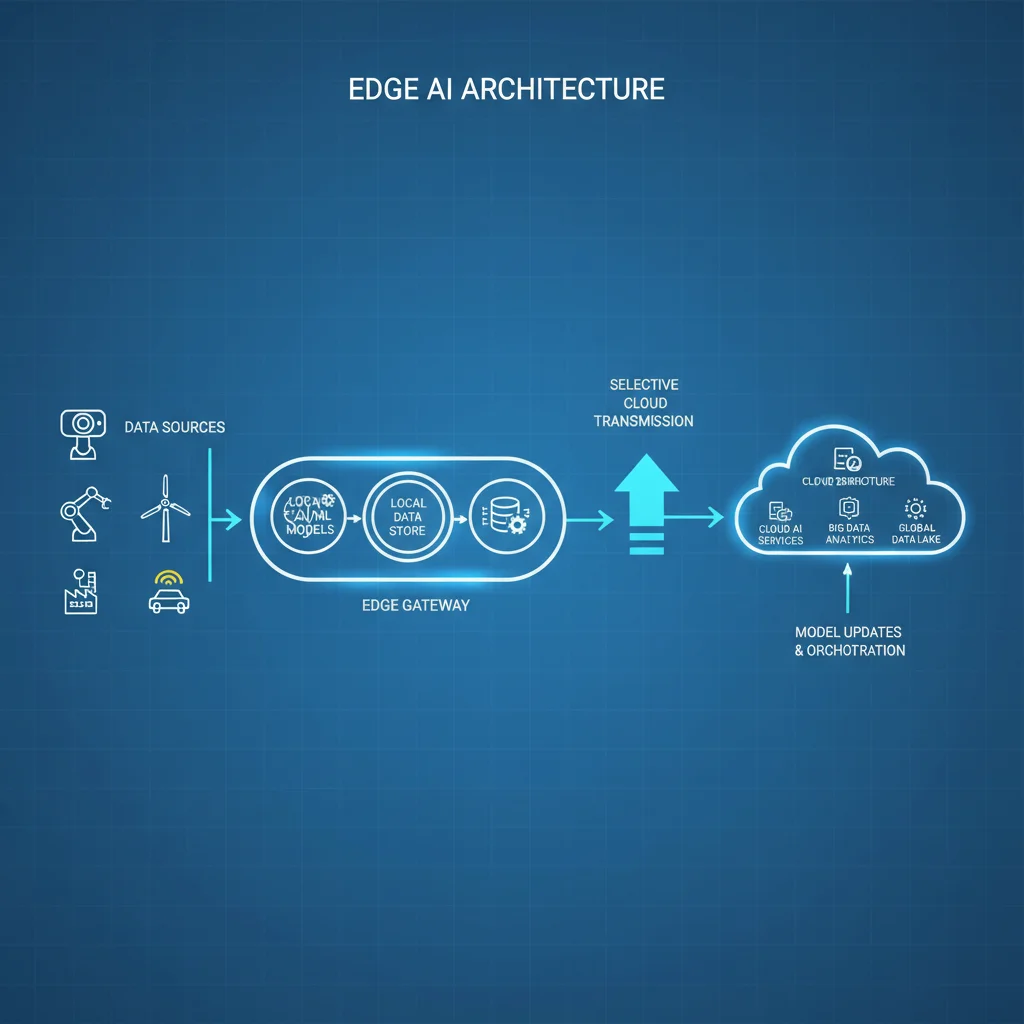
Architectural Considerations: Hybrid Cloud to Edge
A typical Edge AI architecture is often a hybrid model, combining on-premise edge computing with cloud resources. Data is collected and initially processed at the edge, where AI models perform real-time inference. Only relevant, aggregated, or critical data is then transmitted to the cloud for further analysis, long-term storage, model retraining, or centralized management. Key architectural components include:
- Edge Devices: These are the physical devices at the network’s periphery, such as IoT sensors, cameras, industrial controllers, or specialized edge gateways. They collect data and host the AI models for local processing.
- Edge Gateways/Servers: These act as intermediaries, aggregating data from multiple edge devices, performing more complex computations, and often managing local network connectivity.
- Cloud Infrastructure: Used for centralized AI model development and training, large-scale data analytics, long-term storage, and orchestration of edge deployments.
- Connectivity: Reliable and secure communication channels (e.g., 5G, Wi-Fi 6, wired Ethernet) between edge devices, gateways, and the cloud are essential.
Designing this architecture requires careful consideration of data flow, processing locations, and the interplay between edge and cloud components. It’s about finding the right balance to optimize for latency, bandwidth, security, and cost.
Hardware Selection for Edge Deployment
The choice of hardware for your edge deployments is critical. It must be powerful enough to run your chosen AI models, resilient enough to withstand environmental conditions (temperature, vibration, dust), and energy-efficient. Options range from:
- Microcontrollers/Microprocessors: For extremely resource-constrained devices performing simple tasks.
- Single-Board Computers (SBCs): Like Raspberry Pi or NVIDIA Jetson, suitable for more complex tasks requiring a small footprint.
- Edge Servers/Appliances: Ruggedized, purpose-built servers designed for deployment in non-data center environments, offering significant computational power.
- Specialized AI Accelerators: GPUs, NPUs (Neural Processing Units), and FPGAs (Field-Programmable Gate Arrays) can significantly boost AI inference performance at the edge.
Consider factors like power consumption, thermal management, connectivity options, and ruggedization based on the specific operating environment of your edge devices.
Software and Platform Choices
The software stack for Edge AI Adoption is equally important. This includes:
- Operating Systems: Lightweight Linux distributions (e.g., Ubuntu Core, Alpine Linux) or specialized real-time operating systems (RTOS) are common.
- AI Frameworks: TensorFlow Lite, PyTorch Mobile, OpenVINO, and ONNX Runtime are popular choices for deploying optimized AI models on edge devices.
- Edge Orchestration Platforms: Tools like Azure IoT Edge, AWS IoT Greengrass, or Kubernetes-based solutions help manage, deploy, and monitor AI models and applications across a fleet of edge devices.
- Data Management Solutions: Databases and data streams capable of handling local data storage, filtering, and secure transmission.
- Security Software: Robust encryption, authentication, and access control mechanisms are vital for protecting data and models at the edge.
The selection of these technologies should align with your existing IT ecosystem, developer expertise, and long-term scalability goals. Prioritize interoperability and open standards to avoid vendor lock-in and ensure flexibility.
Step 3: Developing, Deploying, and Managing Edge AI Models
Once the architecture and technologies are in place, the core of Edge AI Adoption shifts to the development, deployment, and ongoing management of AI models at the edge. This step involves a unique set of challenges compared to traditional cloud-based AI, primarily due to resource constraints and distributed environments.
Model Development and Optimization for the Edge
AI models destined for edge devices often need to be significantly optimized due to limited computational power, memory, and energy. This involves techniques such as:
- Model Quantization: Reducing the precision of model weights and activations (e.g., from 32-bit floating-point to 8-bit integers) to decrease model size and speed up inference.
- Model Pruning: Removing redundant or less important connections in a neural network without significantly impacting accuracy.
- Knowledge Distillation: Training a smaller, ‘student’ model to mimic the behavior of a larger, more complex ‘teacher’ model.
- Efficient Architectures: Utilizing AI model architectures specifically designed for edge devices, such as MobileNet or EfficientNet.
The goal is to achieve the desired accuracy and performance within the constraints of the edge hardware. This often requires a tight feedback loop between model developers and hardware engineers.
Secure Deployment and Orchestration
Deploying AI models to a potentially vast and geographically dispersed fleet of edge devices requires robust orchestration and management tools. Key considerations for Edge AI Adoption in this phase include:
- Over-the-Air (OTA) Updates: The ability to securely push new model versions, software updates, and security patches to edge devices remotely.
- Device Management: Tools for monitoring the health, status, and performance of edge devices, as well as managing their lifecycle from provisioning to decommissioning.
- Containerization: Using technologies like Docker and Kubernetes to package AI models and their dependencies into lightweight, portable containers, simplifying deployment and ensuring consistency across different edge devices.
- Version Control: Implementing strict version control for AI models and associated software to track changes, enable rollbacks, and ensure reproducibility.
- Zero-Touch Provisioning: Automating the setup and configuration of new edge devices to minimize manual intervention and accelerate deployment.
Security is paramount during deployment. Ensure that all communication channels are encrypted, devices are authenticated, and access controls are strictly enforced to prevent unauthorized access or tampering with models and data.
Continuous Monitoring and Retraining
AI models, especially those operating in dynamic real-world environments, are not static. Their performance can degrade over time due to concept drift (changes in data distribution) or data drift (changes in the input data characteristics). Therefore, continuous monitoring and retraining are essential for successful Edge AI Adoption.
- Performance Monitoring: Track key metrics such as model accuracy, inference latency, resource utilization (CPU, memory), and error rates at the edge.
- Data Collection for Retraining: Strategically collect a subset of inference data from the edge (anonymized if necessary) and send it to the cloud for human review and model retraining.
- Automated Retraining Pipelines: Establish automated pipelines that trigger model retraining when performance degrades or new data patterns emerge.
- A/B Testing at the Edge: Experiment with different model versions on a subset of edge devices to evaluate performance before rolling out updates broadly.
This iterative process of monitoring, collecting data, retraining, and redeploying ensures that your Edge AI models remain accurate, relevant, and effective over their lifecycle.
Step 4: Ensuring Security, Compliance, and Scalability in Edge AI Adoption
The final, but equally crucial, step in a successful Edge AI Adoption strategy involves addressing the critical aspects of security, regulatory compliance, and planning for scalable growth. Neglecting these areas can undermine the benefits of Edge AI and expose the enterprise to significant risks.
Robust Security at the Edge
Edge devices, by their very nature, are often deployed in less controlled environments than traditional data centers, making them potential targets for cyberattacks. A comprehensive security strategy for Edge AI Adoption must encompass:
- Device-Level Security: Implement secure boot mechanisms, hardware-based root of trust, and tamper detection. Ensure strong authentication for device access and management.
- Network Security: Encrypt all data in transit between edge devices, gateways, and the cloud. Utilize VPNs and secure protocols (e.g., TLS) for communication. Implement network segmentation to isolate edge devices and limit lateral movement in case of a breach.
- Data Security: Encrypt data at rest on edge devices. Implement strict access controls to data and AI models. Anonymize or redact sensitive data before processing at the edge or transmitting to the cloud.
- AI Model Security: Protect AI models from adversarial attacks (e.g., data poisoning, model evasion) and intellectual property theft. Implement model integrity checks.
- Regular Audits and Updates: Conduct regular security audits of edge devices and software. Ensure a robust patch management process for timely application of security updates.
A layered security approach, combining physical, network, and software security measures, is essential for protecting your Edge AI deployments.

Navigating Regulatory Compliance and Data Governance
US enterprises operate under a complex web of regulations concerning data privacy and security (e.g., CCPA, HIPAA, industry-specific regulations). Edge AI Adoption introduces new considerations for compliance:
- Data Residency and Sovereignty: Processing data locally at the edge can help comply with data residency requirements by keeping sensitive information within specific geographical boundaries.
- Privacy by Design: Integrate privacy considerations into the design of your Edge AI systems from the outset. This includes data minimization, anonymization, and consent mechanisms.
- Transparency and Explainability: For certain applications (e.g., those impacting individuals), ensure that AI model decisions can be explained and audited to meet regulatory demands.
- Audit Trails: Maintain comprehensive audit trails of data access, model inferences, and system changes at the edge for compliance reporting.
Establish clear data governance policies that define how data is collected, processed, stored, and shared across your edge and cloud infrastructure, ensuring alignment with all applicable regulations.
Planning for Scalability and Future Growth
A successful Edge AI Adoption strategy must be designed with scalability in mind. As your enterprise expands its use of Edge AI, you’ll need to manage a growing number of devices, deploy more complex models, and integrate with new systems. Key aspects of scalability include:
- Automated Provisioning: Tools and processes for rapidly deploying and configuring new edge devices without manual intervention.
- Centralized Management: A unified platform for monitoring, managing, and updating your entire fleet of edge devices and AI models from a single pane of glass.
- Modular Architecture: Design your Edge AI architecture with modular components that can be easily added, removed, or upgraded as needs evolve.
- Resource Optimization: Continuously optimize the use of computational resources at the edge to support more models and applications without requiring costly hardware upgrades.
- Interoperability: Ensure your Edge AI solutions can integrate seamlessly with existing enterprise systems (e.g., ERP, CRM, SCADA) and future technologies.
Planning for scalability from the outset ensures that your initial Edge AI investments can grow and adapt with your enterprise’s evolving digital transformation journey.
The Future is at the Edge: Empowering US Enterprises with AI
The journey of Edge AI Adoption is transformative, offering US enterprises an unparalleled opportunity to redefine their operational efficiencies, enhance customer experiences, and unlock new revenue streams. By bringing intelligence closer to the source of data, businesses can achieve real-time insights, bolster security, and operate with unprecedented autonomy, even in challenging environments.
This 4-step guide – from assessing readiness and identifying use cases, to designing robust architectures, developing and managing models, and finally, ensuring security, compliance, and scalability – provides a clear roadmap for navigating this complex but rewarding landscape. As 2026 approaches, the enterprises that strategically embrace Edge AI Adoption will not just survive but thrive, leading the charge in an increasingly intelligent and interconnected world.
The path to pervasive intelligence is at the edge. By taking a methodical and strategic approach, US businesses can harness the full power of Edge AI, turning challenges into opportunities and setting new benchmarks for innovation and operational excellence.
Related Posts: