AI Revolution: Critical Skills for US Professionals by 2027
The AI revolution is here, demanding new skills from U.S. professionals. This article outlines 3 critical skills crucial by 2027: AI literacy, complex problem-solving, and adaptive learning, providing practical steps to future-proof your career.
By: Matheus Neiva on February 4, 2026
Last updated on: July 28, 2026
The United States is at the forefront of an unprecedented technological transformation driven by Artificial Intelligence (AI). This isn’t just a buzzword; it’s a fundamental shift reshaping industries, job roles, and the very nature of work. As we hurtle towards 2027, the demand for professionals equipped with specific AI skills 2027 will skyrocket, making proactive adaptation not just beneficial, but essential for career longevity and success. This comprehensive guide will delve into the critical skills U.S. professionals must cultivate to not only survive but thrive in this AI-driven future.
The urgency cannot be overstated. Reports from leading institutions like the World Economic Forum and McKinsey & Company consistently highlight AI’s disruptive potential, projecting significant job displacement in routine tasks while simultaneously creating new, highly specialized roles. The gap between existing skill sets and future demands is widening, presenting both a challenge and an immense opportunity for those willing to embrace change and invest in their professional development. Our focus here is on identifying the most impactful AI skills 2027 that will empower U.S. professionals across various sectors.
The AI Revolution: A Defining Moment for U.S. Workforce
AI’s impact is already palpable, from automated customer service to sophisticated data analytics and predictive modeling. By 2027, its integration will be even more pervasive, touching every facet of the U.S. economy. This isn’t about humans competing against machines; it’s about humans learning to collaborate with intelligent systems, leveraging AI’s capabilities to augment human potential. The critical shift lies in understanding that AI doesn’t just automate tasks; it fundamentally changes how problems are solved, decisions are made, and value is created.
For U.S. professionals, this means a re-evaluation of traditional skill sets. Repetitive, rule-based tasks are increasingly vulnerable to automation. The value proposition of human workers will increasingly hinge on uniquely human attributes and skills that AI cannot easily replicate. This includes creativity, emotional intelligence, strategic thinking, and complex problem-solving – all underpinned by a foundational understanding of AI’s capabilities and limitations. The journey to acquiring these AI skills 2027 starts now.
Critical Skill 1: AI Literacy and Ethical AI Understanding
At the core of preparing for the AI-driven future is developing robust AI literacy. This isn’t about becoming an AI developer, but rather understanding what AI is, how it works, its various applications, and its societal implications. For U.S. professionals, this foundational AI skill 2027 is paramount across all industries. It’s about being able to intelligently interact with AI tools, interpret their outputs, and understand their limitations. Think of it like digital literacy in the early 2000s; it’s no longer a niche skill but a universal requirement.
What is AI Literacy?
Understanding AI Fundamentals: Grasping core concepts like machine learning, deep learning, natural language processing (NLP), and computer vision. Knowing the difference between supervised and unsupervised learning, for instance, allows for more informed decision-making when selecting or utilizing AI tools.
Interpreting AI Outputs: Being able to critically evaluate the data and insights generated by AI systems. This includes understanding confidence scores, identifying potential biases, and recognizing when an AI model might be making an unreliable prediction.
Identifying AI Applications: Recognizing where AI can add value in your specific role or industry. This involves seeing opportunities for automation, optimization, and innovation through AI.
Communicating with AI Systems: Learning how to formulate effective prompts for generative AI tools, understand AI-driven dashboards, and convey requirements to AI development teams.
The Imperative of Ethical AI Understanding
Beyond technical comprehension, ethical AI understanding is a non-negotiable AI skill 2027. As AI becomes more powerful and autonomous, the ethical implications become more significant. U.S. professionals will be increasingly called upon to make decisions that balance technological advancement with human values, fairness, and privacy.
Bias Detection and Mitigation: Understanding how biases can be inadvertently introduced into AI models through data or algorithmic design, and knowing strategies to identify and mitigate them. This is crucial for ensuring equitable outcomes in areas like hiring, lending, and healthcare.
Privacy and Data Governance: Being aware of regulations like GDPR and emerging U.S. data privacy laws, and understanding how AI systems process and utilize sensitive information. Professionals need to advocate for responsible data handling.
Transparency and Explainability: The ability to understand and explain how an AI system arrived at a particular decision (interpretability and explainability). This is vital in fields where decisions have significant human impact, such as finance or medicine.
Accountability: Knowing who is responsible when an AI system makes an error or causes harm. This involves understanding the chain of command and ethical frameworks for AI deployment.
Practical Steps to Develop AI Literacy and Ethical Understanding:
Online Courses: Platforms like Coursera, edX, and Udacity offer excellent introductory courses on AI, machine learning, and AI ethics. Look for courses from reputable universities and industry leaders.
Industry-Specific Workshops: Many professional organizations are now offering workshops tailored to AI applications and ethics within specific sectors (e.g., AI in Healthcare, AI in Finance).
Read and Research: Stay updated with AI news, research papers, and thought leadership from organizations like the AI Policy Institute or the Partnership on AI.
Experiment with Tools: Get hands-on experience with readily available AI tools, even consumer-grade ones like ChatGPT or Midjourney, to understand their capabilities and limitations firsthand.
Critical Skill 2: Complex Problem-Solving and Critical Thinking in an AI Context
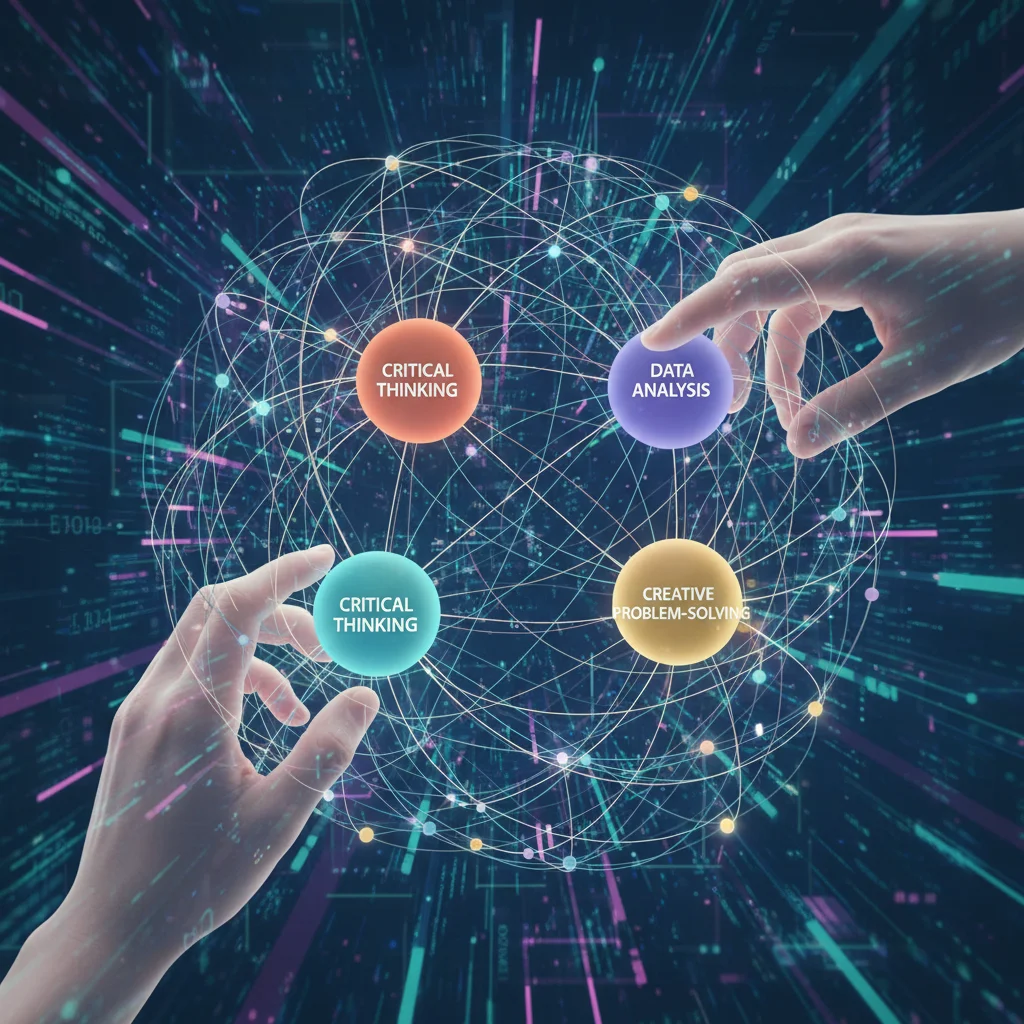
While AI excels at processing vast amounts of data and identifying patterns, it often struggles with truly novel, ill-defined, or ethically complex problems. This is where human intelligence, particularly complex problem-solving and critical thinking, becomes indispensable. These are paramount AI skills 2027 for U.S. professionals. The ability to frame problems, synthesize information from diverse sources (including AI outputs), and devise innovative solutions will be highly valued.
Redefining Problem-Solving with AI
In an AI-augmented world, complex problem-solving isn’t about doing everything yourself; it’s about strategically leveraging AI to enhance your problem-solving capabilities. It involves:
Problem Framing: Defining the core problem clearly, identifying relevant variables, and understanding the context – tasks that often require nuanced human insight that AI cannot fully replicate.
Data-Driven Inquiry: Using AI to analyze vast datasets, identify trends, and generate hypotheses, then employing critical thinking to validate or challenge those hypotheses.
Synthesizing AI Insights: Integrating information from various AI tools (e.g., predictive analytics, natural language generation) with human expertise and qualitative data to form a holistic understanding.
Scenario Planning and Risk Assessment: Utilizing AI for simulations and predictive modeling, but then applying human judgment to assess risks, consider unforeseen consequences, and develop contingency plans that AI might overlook.
The Enduring Power of Critical Thinking
Critical thinking, already a vital skill, becomes even more crucial in an AI-saturated environment. It’s the ability to question, analyze, evaluate, and interpret information, especially when that information comes from an AI source. For U.S. professionals, this AI skill 2027 means:
Questioning AI Outputs: Not blindly accepting AI-generated recommendations or analyses. Asking: ‘Is this logical? Are there alternative explanations? What data was this based on? Could there be biases?’
Identifying Limitations: Understanding that AI models are only as good as the data they’re trained on and the algorithms they use. Recognizing when an AI might be operating outside its trained domain or providing a ‘hallucination.’
Logical Reasoning: Applying deductive and inductive reasoning to evaluate AI-generated insights and integrate them into broader strategic thinking.
Creative Solutioning: While AI can generate options, the truly innovative, disruptive solutions often emerge from human creativity, intuition, and the ability to connect disparate ideas.
Developing Your Complex Problem-Solving and Critical Thinking:
Engage in ‘What If’ Scenarios: Regularly practice scenario planning in your work, considering various outcomes and how AI might influence them.
Seek Diverse Perspectives: Collaborate with colleagues from different departments or backgrounds to broaden your problem-solving approach.
Formal Training in Logic and Analytics: Consider courses in analytical reasoning, statistics, or even philosophy to sharpen your critical thinking faculties.
Case Study Analysis: Work through complex business or industry case studies, focusing on how AI tools could be integrated into the problem-solving process.
Critical Skill 3: Adaptability and Continuous Learning in a Rapidly Evolving Landscape
Perhaps the most overarching and vital AI skill 2027 for U.S. professionals is an unwavering commitment to adaptability and continuous learning. The pace of AI development is staggering, meaning that skills learned today might be refined or even superseded tomorrow. A growth mindset, resilience, and the ability to quickly acquire new knowledge and unlearn outdated approaches will be non-negotiable.
The Essence of Adaptability
Adaptability in the AI era means more than just being open to change; it means actively seeking it out and integrating it into your professional identity. For U.S. professionals, this translates to:
Embracing New Technologies: Being willing to experiment with new AI tools and platforms as they emerge, rather than resisting them. This includes being an early adopter or at least a rapid learner of new AI functionalities.
Role Fluidity: Understanding that job descriptions will evolve. The ability to pivot between different tasks, take on new responsibilities, and even transition to entirely new roles will be crucial.
Resilience to Disruption: Developing the mental fortitude to navigate periods of uncertainty and disruption caused by technological shifts. Viewing challenges as opportunities for growth.
Cross-Functional Collaboration: Working effectively with individuals from diverse backgrounds, including AI specialists, data scientists, and ethicists, to integrate AI solutions seamlessly.
The Imperative of Continuous Learning
Continuous learning moves from a ‘nice-to-have’ to a ‘must-have’ in the AI age. The shelf life of skills is shortening dramatically. For U.S. professionals, investing in ongoing education and self-development is the best hedge against obsolescence, making it a critical AI skill 2027.
Upskilling and Reskilling: Actively pursuing opportunities to learn new skills (upskilling) or entirely new sets of skills (reskilling) that are relevant to AI-driven roles.
Micro-credentials and Certifications: Leveraging short, focused learning programs that provide specific, job-relevant skills, often offered by tech companies (e.g., Google AI certifications, Microsoft Azure AI certifications) or online learning platforms.
Networking and Knowledge Sharing: Engaging with professional communities, attending conferences (virtual or in-person), and participating in forums where AI insights are shared. Learning from peers and experts is invaluable.
Personal Learning Plans: Proactively developing a personal learning roadmap, identifying areas for growth, and setting goals for acquiring new AI skills.
Strategies for Fostering Adaptability and Continuous Learning:
Allocate Dedicated Learning Time: Treat learning as a core part of your job, not an afterthought. Dedicate specific hours each week to professional development.
Embrace a Growth Mindset: Cultivate the belief that your abilities can be developed through dedication and hard work. View challenges as opportunities to learn.
Seek Feedback: Regularly solicit feedback on your performance and areas for improvement, especially concerning new technologies and approaches.
Mentor and Be Mentored: Both teaching others and learning from more experienced individuals can accelerate your development.
Beyond the Big Three: Complementary Skills for the AI Era
While AI literacy, complex problem-solving, and adaptability form the bedrock of future success, several complementary skills will further enhance a U.S. professional’s career trajectory by 2027:
Data Fluency: The ability to understand, analyze, and communicate with data, even if not a data scientist. This includes basic statistical understanding, data visualization, and the ability to interpret data insights generated by AI tools.
Collaboration and Teamwork: As roles become more interdisciplinary, the ability to work effectively in diverse teams, often including remote or AI-augmented collaborators, will be paramount.
Creativity and Innovation: AI can automate routine creative tasks, but true innovation and artistic expression remain human domains. Leveraging AI as a creative partner rather than a replacement is key.
Emotional Intelligence: Understanding and managing one’s own emotions, and accurately perceiving and influencing the emotions of others. This is critical for leadership, negotiation, and building strong human connections in an increasingly digital world.
Digital Dexterity: Beyond just knowing how to use software, it’s the intuition and agility to navigate new digital environments, integrate different technologies, and troubleshoot technical issues effectively.
The Time to Act is Now: Future-Proofing Your Career
The year 2027 might seem distant, but the groundwork for success in an AI-driven economy must be laid today. For U.S. professionals, ignoring the shifts brought by AI is no longer an option. The choice is clear: either evolve with the technology or risk being left behind. Developing these AI skills 2027 is not just about securing a job; it’s about unlocking new opportunities, driving innovation, and shaping a more intelligent and efficient future.
Start by assessing your current skill set. Identify gaps related to AI literacy, complex problem-solving, and adaptability. Then, create a personalized development plan. This might involve enrolling in online courses, seeking mentorship, participating in industry forums, or simply dedicating time each week to learn about new AI advancements. Remember, the goal is not to become an AI expert in every domain, but to become an AI-savvy professional who can effectively leverage these powerful tools.
Employers also have a crucial role to play. Investing in employee training and development, fostering a culture of continuous learning, and providing opportunities for experimentation with AI tools will be vital for maintaining a competitive workforce. The collaboration between individual professionals and organizations will accelerate the collective adaptation to the AI revolution.
The future of work is not a dystopian vision of machines replacing humans. Instead, it’s a synergistic partnership where AI handles the computational heavy lifting, freeing U.S. professionals to focus on higher-order tasks that require uniquely human cognitive and emotional capacities. By focusing on these critical AI skills 2027 – AI literacy and ethical understanding, complex problem-solving and critical thinking, and unwavering adaptability – you can ensure your place at the forefront of this exciting new era.
Embrace the challenge, seize the opportunity, and prepare to redefine your professional journey in the age of artificial intelligence. Your future, and the future of the U.S. workforce, depends on it.
Matheus Neiva has a degree in Communication and a specialization in Digital Marketing. Working as a writer, he dedicates himself to researching and creating informative content, always seeking to convey information clearly and accurately to the public.